A dramatic photo — say a local railway station in flames — reaches you on social media. How does a journalist proceed before reporting anything?
Treat the image as an unverified claim, not an event: trace its provenance, confirm with primary sources, pin down the facts with the W-questions — and publish nothing until independent sources corroborate it.
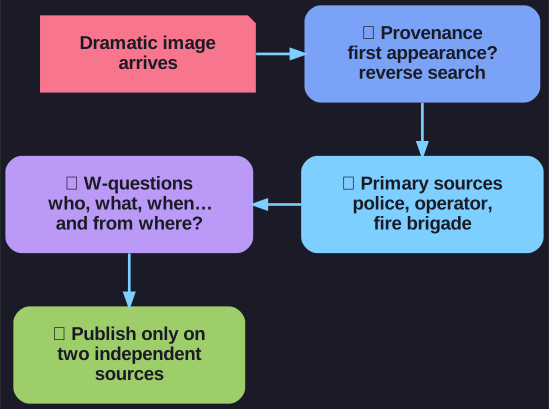
* The image is a claim entering a pipeline — four checks stand between it and publication. *
A photorealistic picture of exactly such a scene can be generated in minutes — so "it looks real" establishes nothing, and the disciplined sequence is:
- Provenance first — where did the image first appear, and who posted it? A reverse image search shows whether it is recycled from an older event; no credible earlier appearance plus no reporting anywhere is a red flag, not a scoop.
- Go to primary sources — call the fire brigade, the police, the railway operator. An event that dramatic leaves official traces within minutes; if the people who would be fighting the fire know nothing, you likely hold a fake.
- Pin down the W-questions — who, what, when, where, how, why, and above all from where does the information come. Every fact must trace to a source you can name and defend.
- Publish only on corroboration — at least two independent sources describing the same course of events, per the two-source rule.
The order matters: verification happens before publication, because under always-on deadline pressure a false image published "provisionally" gets copied across other portals faster than any correction can follow it.
Go deeper:
 Verification Handbook — the standard newsroom guide to verifying user-generated images and video in breaking-news situations.