Beyond generalization and suppression, what other transformation techniques are used to de-identify data?
Perturbation (adding noise), swapping values between records, and calibrated noise for differential privacy — alongside the suppression and generalization you already know.
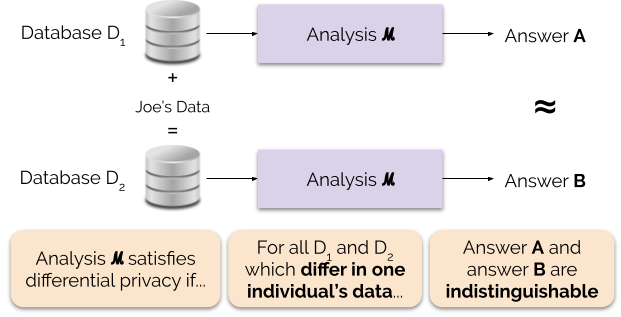
* Calibrated noise behind differential privacy. — Near, Darais & Boeckl, Public domain, via Wikimedia Commons. *
The FPF visual guide lists the practical toolbox used to move data along the de-identification spectrum:
- Suppression — delete or blank a value (replace with
*). - Generalization — coarsen a value (GPA 3.2 → range 3.0-3.5).
- Perturbation / swapping — alter values slightly or swap them between records (e.g. swap one person's gender field with another's), so individual rows are no longer truthful even though aggregate statistics survive.
- Calibrated noise (differential privacy) — add carefully tuned random noise so an attacker cannot tell whether any single individual is in the dataset — the formal guarantee that marks "anonymous" on the spectrum.
The trade-off is the familiar one: each technique distorts the data to hide individuals, costing some accuracy. Perturbation and swapping preserve column-level statistics better than blanket suppression, which is why they appear in real de-identified releases.
Tip: Generalization/suppression make values coarser; perturbation/swapping make individual values untrue while keeping the aggregate honest. Different tools, same goal — break the line from a row to a person.
Go deeper:
 A Visual Guide to Practical Data De-Identification (FPF) — lists suppression/generalization/perturbation/noise.
 Data anonymization (Wikipedia) — covers permutation/swapping and perturbation operations.