Blockchain energy projects can be sorted into developmental stages by how much they actually contribute to grid stability. What distinguishes Stage I, Stage II, and Stage III?
Stage I platforms only trade (transparent P2P markets, no stability control); Stage II adds distributed control but scales poorly and lacks macro regulation; Stage III is a full infrastructure: endpoint forecasting, incentive-embedded trading, and macro coordination together.
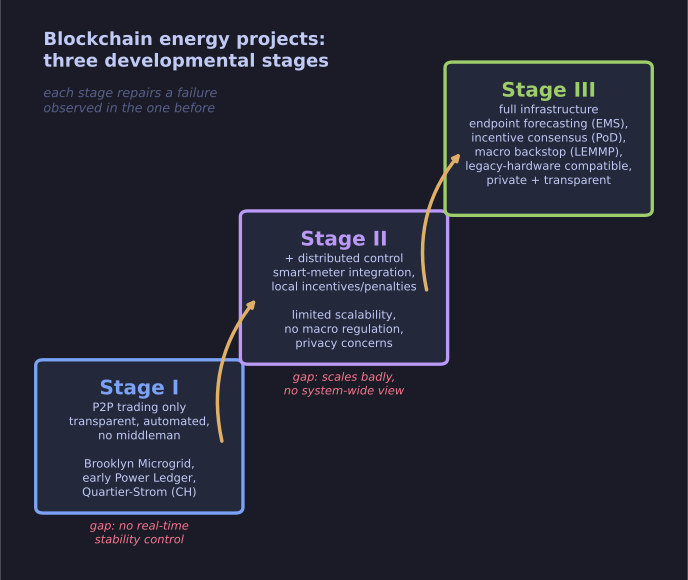
* The maturity staircase: trading alone, then distributed control, then a full three-layer stability infrastructure — each step closes the gap the one below left open. *
The stages measure a progression from "a market on a blockchain" to "a grid that regulates itself":
- Stage I — relative stability through P2P trading alone. Projects like the Brooklyn Microgrid, the initial Power Ledger, and Switzerland's Quartier-Strom pilot proved that blockchain trading works: transparent, automated, intermediary-free. But they run on business logic only — no dynamic feedback control, no coordination with what the physical grid needs in real time.
- Stage II — distributed control with limited effectiveness. Later systems wired blockchains to smart meters for demand-side management and added local incentive/penalty schemes tied to network balance. The limits: real-time meter integration scales badly, there is still no effective macro-level regulation, and pushing meter data on-chain raises privacy concerns.
- Stage III — the full trading infrastructure. The target design: accurate forecasting at every endpoint, incentives built into the transaction logic itself, macro regulation without re-centralising power, compatibility with legacy hardware, and transparency with privacy preserved.
The stage model explains why the architecture has its three layers — each layer repairs a failure observed in an earlier stage.
Go deeper:
 Quartierstrom: a decentralized local P2P energy market pilot (arXiv) — the Swiss Walenstadt neighbourhood pilot: what a real Stage I deployment looked like.