Quiz Entry - updated: 2026.07.30
CSMA/CD vs CSMA/CA — which technology uses which, and why does each fit its medium?
Wired legacy Ethernet uses CSMA/CD; wireless 802.11 WLANs use CSMA/CA. Wired nodes can hear collisions on the cable, but wireless nodes often can't, so they avoid collisions instead of detecting them.
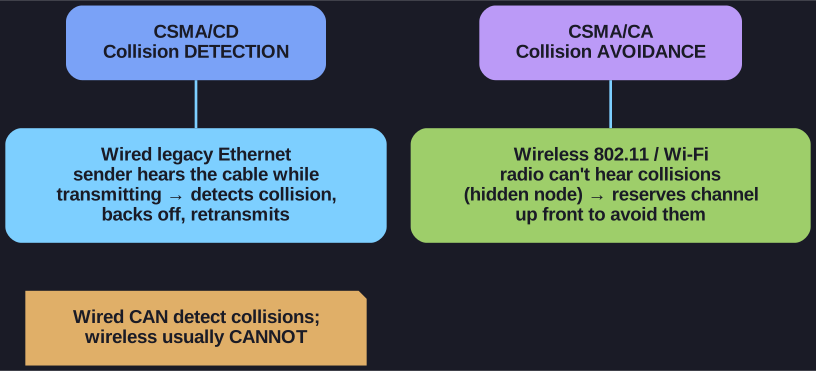
* Wired Ethernet can detect collisions on the cable; wireless usually cannot, so it avoids them instead. *
| CSMA/CD | CSMA/CA | |
|---|---|---|
| Meaning | Collision Detection | Collision Avoidance |
| Used by | Legacy bus-topology Ethernet LANs (wired) | IEEE 802.11 WLANs / Wi-Fi (wireless) |
| Strategy | Let collisions happen, detect them, wait a random time, retransmit | Announce transmission duration up front so others wait, avoiding collisions |
| Duplex | Half-duplex | Half-duplex |
Why the split: On a shared cable a sender can listen while transmitting and notice a collision. On wireless, a station usually cannot detect a collision while transmitting (the hidden-node problem), so Wi-Fi must avoid collisions before they occur rather than detect them afterward.
Go deeper:
 Hidden node problem (Wikipedia) — the core reason wireless can't rely on detection: stations hear the AP but not each other, so collisions go unseen; RTS/CTS as the workaround.
- Collision Avoidance / CSMA/CA (NetworkAcademy.IO) — states it plainly: wired CSMA/CD detects collisions because it can hear them; wireless CSMA/CA must prevent them.