Given 192.168.1.0/24, create 4 equal subnets — walk through the borrowed bits, new prefix, mask, and the 4 network addresses with their broadcasts.
Borrow 2 bits → /26 (255.255.255.192), magic number 64; the four networks are .0, .64, .128, .192, with broadcasts .63, .127, .191, .255.
To create N equal subnets you borrow host bits until 2^n reaches N — here 4 subnets need n = 2 borrowed bits because 2^2 = 4 exactly. Borrowing 2 bits pushes the prefix from /24 to /26, which fills the last octet with two extra network bits (11000000 = 192), so the mask is 255.255.255.192. The magic number 256 − 192 = 64 is the spacing between networks, so you step the last octet 0, 64, 128, 192. Each /26 keeps 6 host bits, and 2^6 − 2 = 62 usable hosts (you always lose the all-0s network address and all-1s broadcast). This is the most common subnetting drill, so memorise the pattern: more subnets means borrowing more bits, which means a longer prefix and fewer hosts each.
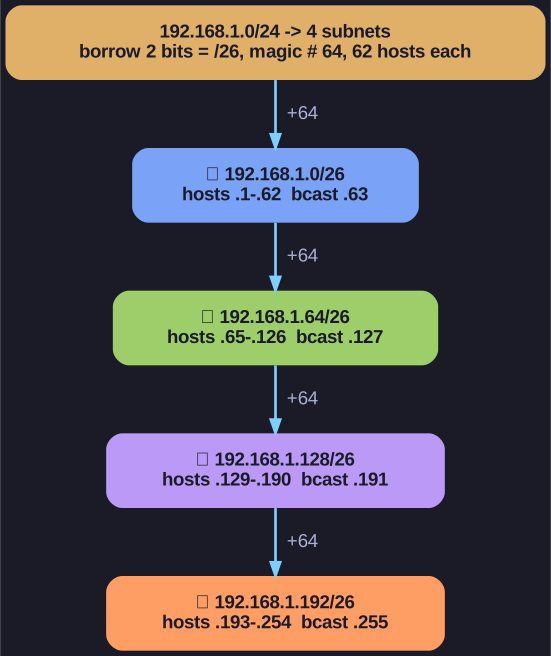
* Four /26 subnets: borrow 2 bits, step the last octet by the magic number 64. *
Step-by-step:
- Need 4 subnets → 2^n ≥ 4 → borrow n = 2 bits (2^2 = 4).
- New prefix: /24 + 2 = /26; mask = 255.255.255.192 (last octet 11000000).
- Magic number = 256 − 192 = 64 → subnets step by 64.
- Host bits left = 32 − 26 = 6 → usable hosts = 2^6 − 2 = 62 per subnet.
| Subnet | Network | First Host | Last Host | Broadcast |
|---|---|---|---|---|
| 1 | 192.168.1.0/26 | .1 | .62 | .63 |
| 2 | 192.168.1.64/26 | .65 | .126 | .127 |
| 3 | 192.168.1.128/26 | .129 | .190 | .191 |
| 4 | 192.168.1.192/26 | .193 | .254 | .255 |
Check: each broadcast = next network − 1 (e.g. .64 − 1 = .63). Same method gives 192.168.10.0/24 → 4 subnets at .0/.64/.128/.192.
Go deeper:
 Visual Subnet Calculator (davidc.net) — enter 192.168.1.0/24 and split it into four /26s to see the same boundaries.
 Subnetting is simple — Sunny Classroom (YouTube) — works equal-subnet examples like this one.