Quiz Entry - updated: 2026.07.30
How are IPv4 addresses structured in terms of bits and octets?
An IPv4 address is 32 bits split into 4 octets of 8 bits each; each octet is shown as a decimal 0-255 separated by dots (dotted decimal notation).
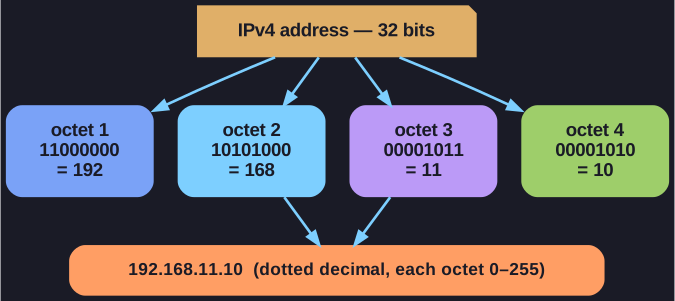
* 32 bits → four octets → dotted decimal: 11000000.10101000.00001011.00001010 = 192.168.11.10. *
IPv4 Address Structure:
- 32 bits total divided into 4 groups of 8 bits
- Each 8-bit group is called an octet
- Each octet is converted to decimal (0-255)
- Octets are separated by periods: Dotted Decimal Notation
Example:
Binary:     11000000.10101000.00001010.00001010
Decimal:    192.168.10.10
Key point: Routers and computers process IPv4 addresses in binary, but humans use dotted decimal for readability.
Go deeper:
 Wikipedia — IPv4 — the 32-bit address space, octets, and dotted-decimal notation in full.