Quiz Entry - updated: 2026.07.30
How are multidimensional arrays laid out in memory?
C stores 2D arrays in row-major order — one whole row laid out contiguously, then the next — so arr[i][j] lives at base + (i*N_cols + j)*sizeof(elem).
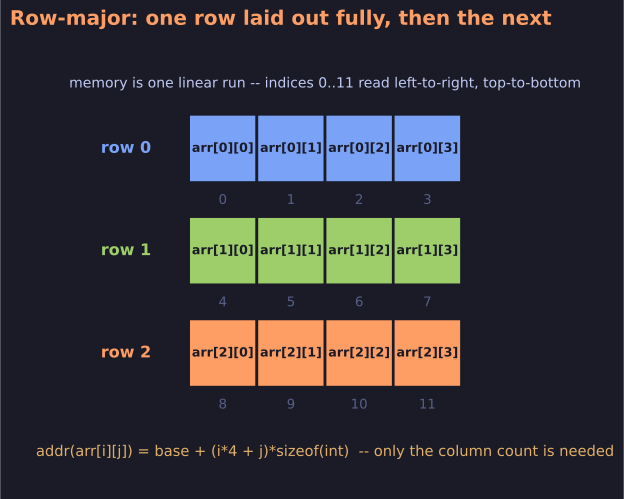
* Row-major: row 0 is laid out fully, then row 1, then row 2 — so arr[i][j] sits at base + (i·cols + j)·size. *
Declaration:
// 3 rows, 4 columns
int arr[3][4];
// Type: "array of 3 arrays of 4 ints"
Memory layout (row-major):
arr[0][0] arr[0][1] arr[0][2] arr[0][3] arr[1][0] arr[1][1] ...
|---------- row 0 -----------|---------- row 1 ---------|
Size calculation:
- One element:
sizeof(int)= 4 bytes - One row:
4 * sizeof(int)= 16 bytes - Entire array:
3 * 4 * sizeof(int)= 48 bytes
Address calculation for arr[i][j]:
address = base + (i * N_cols + j) * sizeof(element)
// Or equivalently:
address = base + i * sizeof(row) + j * sizeof(element)
Example: For int arr[3][4] at address 1000:
arr[2][1] = 1000 + (2 * 4 + 1) * 4 = 1000 + 36 = 1036
Key insight for reverse engineering:
- To find
arr[i][j], compiler only needsN_cols, notN_rows - The formula
i * N_cols + jappears in assembly - Look for multiply-add patterns:
lea (%rdi,%rsi,4), %rax
Contrast with pointer-to-pointer:
// Pointer to pointer - NOT a 2D array!
int **p;
// True 2D array - contiguous memory
int arr[3][4];
Go deeper:
 Row- and column-major order — Wikipedia — the two array layouts and their cache implications.