Quiz Entry - updated: 2026.07.30
How are strings represented in C?
A string is just a char array (ASCII-encoded) whose end is marked by a \0 null byte — there's no separate string type or stored length.
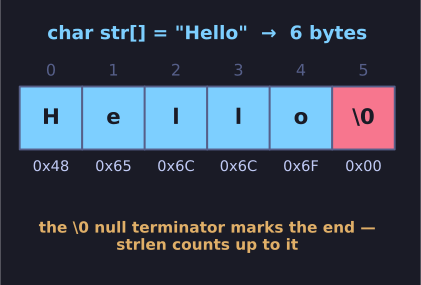
* "Hello" is five characters plus a \0 terminator — 6 bytes, with no separately stored length. *
// Actually 6 bytes: H e l l o \0
char str[] = "Hello";
In memory:
| Index | 0 | 1 | 2 | 3 | 4 | 5 |
|---|---|---|---|---|---|---|
| Char | 'H' | 'e' | 'l' | 'l' | 'o' | '\0' |
| Hex | 0x48 | 0x65 | 0x6C | 0x6C | 0x6F | 0x00 |
The null terminator \0:
- Marks the end of the string
- ASCII value 0 (not the character '0' which is 0x30)
- Functions like
strlen()count until they hit\0
Escape sequences:
| Escape | Meaning |
|---|---|
\n |
Newline |
\t |
Tab |
\" |
Double quote |
\\ |
Backslash |
\0 |
Null character |
Safe string handling:
char str[128];
// Prevents overflow
snprintf(str, sizeof(str), "%d arguments\n", argc);
// NOT sprintf(str, ...) which can overflow!
Go deeper:
 C string handling — Wikipedia — the null-terminated convention, the standard string functions, and their pitfalls.