Quiz Entry - updated: 2026.10.26
How can a block cipher be used as a pseudorandom function (PRF) or for key derivation (KDF)?
By encrypting a counter or label with a secret key, a block cipher can generate pseudorandom output suitable for deriving multiple keys from a single master key.
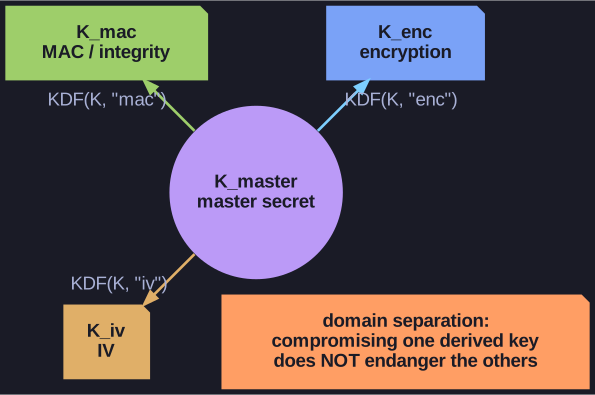
* A KDF splits one master secret into separate purpose-specific keys, giving domain separation. *
Block cipher as PRF:
$$\text{Output}_i = E(K, i) \quad\text{(encrypt counter values } 0, 1, 2, \dots\text{)}$$
This produces a sequence of pseudorandom blocks, similar to CTR mode but used for key generation rather than encryption.
Key Derivation Function (KDF):
- Input: a master key $K_{\text{master}}$
- Output: multiple derived keys for different purposes
- Example: $K_{\text{enc}} = E(K_{\text{master}}, 1)$, $K_{\text{mac}} = E(K_{\text{master}}, 2)$, $K_{\text{iv}} = E(K_{\text{master}}, 3)$
Why use a KDF?
- Never use the same key for multiple purposes
- A single shared secret (from key exchange) needs to produce multiple keys
- KDFs add domain separation — even if one derived key is compromised, others remain safe
Standard KDFs:
- HKDF (HMAC-based) — most common in TLS
- NIST SP 800-108 — uses block ciphers or HMAC
- PBKDF2 — for password-based key derivation (adds salt and iterations)
Go deeper:
 Key derivation function (Wikipedia) — HKDF, PBKDF2, and why one secret becomes many keys.
- RFC 5869 — HKDF — the extract-and-expand KDF used throughout TLS.