How can Time of Flight / Time of Arrival refine a cell-based location estimate?
By measuring how long a data packet took to travel, you can estimate the device's distance from the antenna, which further reduces the candidate area — but as of the early 2020s there was no empirical study validating ToF/ToA for this forensic use.
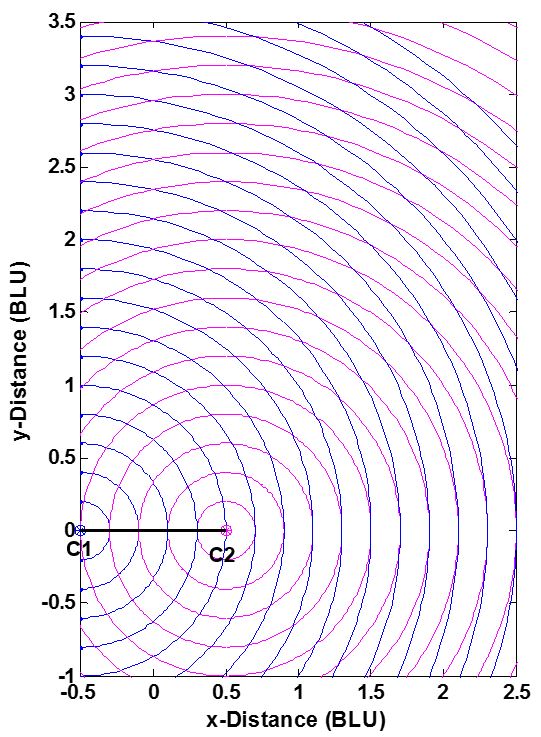
* Distance rings from towers intersect to fix a position. — NavigationGuy, CC BY-SA 4.0, via Wikimedia Commons. *
The idea behind Time of Flight (ToF) / Time of Arrival (ToA) is to ask how long a data packet was in transit. Because radio waves travel at a known speed, that travel time converts directly into a distance of the device from the antenna. This further reduces the candidate area: instead of the whole cell footprint, you get a ring or arc at roughly the measured distance from the antenna, and where several such rings cross you can pin a position more tightly still.
The important caveat is that, as of the early 2020s, there was no known empirical study validating ToF/ToA for this specific forensic purpose (per Jovanovic & Cummings 2022, a review of mobile-phone geolocation methods used in US courts).
That caveat matters because a technique can be physically sound yet still lack the empirical validation needed to be relied upon as evidence. Distance-from-timing sounds compelling, but without studies quantifying its accuracy and error rates under real-world conditions, its evidential weight stays uncertain. This is a recurring theme in digital forensics: the gap between "physically plausible" and "validated for court" is exactly where careful expert testimony lives.
Tip: ToF/ToA turns a cell-area estimate into a distance-arc estimate — promising, but treat its precision with caution absent empirical validation.
Go deeper:
 Timing advance (Wikipedia) — round-trip signal timing yields the device's distance from the base station, the basis of the ToA/ToF arc.
- Mobile Phone Geolocation Methods Used in US Courts (IEEE Access, 2022) — a peer-reviewed survey questioning the forensic validity of timing/cell-based location in court.