How did open-source investigators re-examine the police shooting of Mark Duggan, and what does it show about the direction SOCMINT can point?
Researchers reconstructed the 2011 shooting from open-source video, photos, and 3D modelling to independently test the official account — turning investigative techniques onto the state rather than onto a citizen.
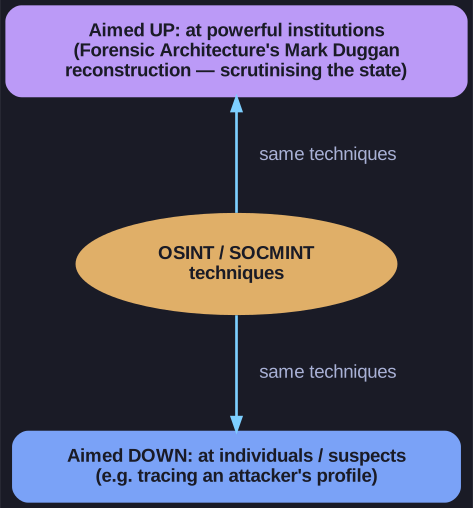
* The same techniques point "down" at suspects or "up" at the powerful — Forensic Architecture pointed them at the state. *
Mark Duggan was shot dead by Metropolitan Police in Tottenham, London, on 4 August 2011; the contested circumstances helped trigger the 2011 England riots. The research agency Forensic Architecture later produced a detailed open-source reconstruction of the incident (forensic-architecture.org), assembling scattered media into a spatial, time-synced model of what happened.
Why this case matters conceptually:
- Counter-forensics / accountability: Open-source investigation isn't only a tool of states against individuals — civil society, journalists, and researchers use the same techniques to scrutinize the powerful and verify official narratives.
- Reconstruction from fragments: No single clip showed everything; the method was to fuse many partial public sources into one coherent account.
- Reproducibility: Because it's built from public material, others can audit the reconstruction — the traceability principle in action.
Tip: This "investigate upward" use of OSINT is a defining feature of modern open-source journalism — the lens points at authorities and corporations, not just suspects.
Go deeper:
 Killing of Mark Duggan (Wikipedia) — the case background, contested account and resulting riots.
- Forensic Architecture (Wikipedia) — the group whose open-source reconstruction "investigates upward".
- 2011 England riots (Wikipedia) — the unrest Duggan's shooting triggered.