Quiz Entry - updated: 2026.07.30
How did the architecture evolve from 2G (voice only) to 2.5G (voice + data)?
2.5G (GPRS) added a parallel packet-switched data network alongside the existing circuit-switched voice network — the two run independently, sharing only the radio access.
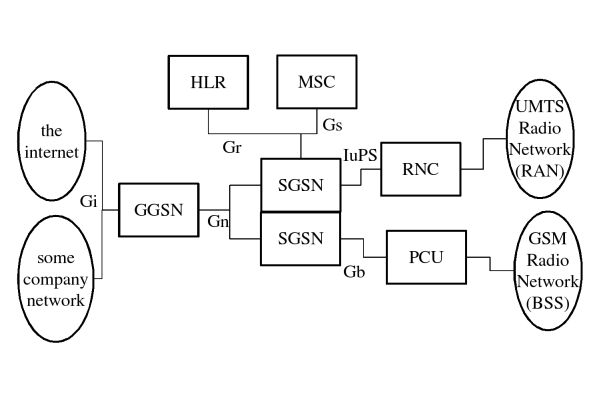
* GPRS adds SGSN/GGSN beside the GSM voice core. — Mozzerati, CC BY-SA 3.0, via Wikimedia Commons. *
2G architecture (voice only):
MS → BTS → BSC → MSC → Gateway MSC → Telephone Network
- Pure circuit-switched — every connection gets a dedicated channel
- Only voice and SMS
2.5G architecture (voice + data):
Voice: MS → BTS → BSC → MSC → Gateway MSC → Telephone Network
Data:  MS → BTS → BSC → SGSN → GGSN → Internet
- GPRS added two new nodes: SGSN and GGSN
- Instead of circuit switching (like GSM for voice), GPRS uses packet switching with TCP/IP
- The voice network (MSC) remains completely unchanged — the data network runs in parallel
Key architectural insight:
- The voice network in the core is unmodified — operators didn't have to replace their MSCs
- The data network works in parallel alongside voice
- The radio access (BTS, BSC) is shared — the BSC decides whether to route traffic to the MSC (voice) or SGSN (data)
- SGSN handles: mobility management, authentication for data sessions
- GGSN handles: IP address assignment, gateway to the internet
Go deeper:
 GPRS core network (Wikipedia) — how SGSN and GGSN bolt a packet-switched data path onto the unchanged GSM voice core.