How did the Netflix Prize re-identification work, and what were its consequences?
Researchers linked Netflix's "anonymized" movie ratings to public IMDb profiles — ~8 dated ratings re-identified users with 99% accuracy — triggering a cancelled sequel and a lawsuit.
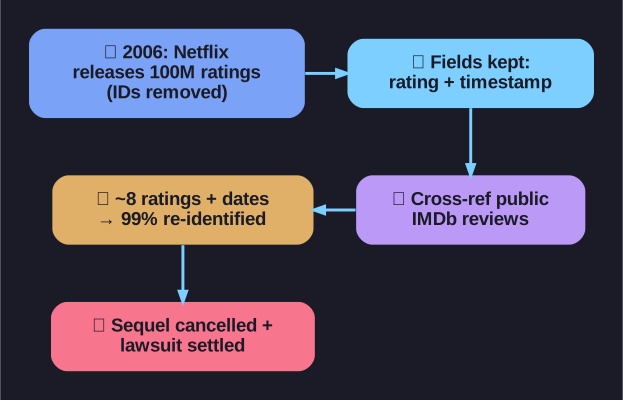
* The Netflix Prize de-anonymization, from release to legal fallout. *
In October 2006 Netflix published ~100 million ratings from ~500,000 subscribers to crowdsource a better recommendation algorithm (a $1M prize). It stripped names and obvious identifiers and assumed that made the data anonymous — but it kept four fields per row: an anonymized user ID, the movie title, the rating (1–5 stars), and a timestamp. That last detail is the whole story: when you rated a film, combined with which films, is a behavioral fingerprint.
In December 2007 UT Austin researchers Arvind Narayanan and Vitaly Shmatikov showed why. They cross-referenced the release against public IMDb reviews — where people rate the same films under their real names and dates. Because almost no two people rate the same handful of obscure films at the same times, knowing as few as ~8 of a person's ratings (even with 2 of them wrong) and the approximate dates was enough to single out 99% of records. No password was cracked; the attacker simply matched one public dataset to another on shared behavior — a textbook linkage attack, just on movie habits instead of birthdate/ZIP.
The fallout cemented the lesson. Netflix cancelled the planned second Prize, and a class-action privacy lawsuit was filed and settled out of court. Academically the result became a rallying point for rigorous, provable models like differential privacy, because it proved that ad-hoc "remove the names" anonymization is no defense. And across industry it reframed the risk: releasing rich behavioral data — purchases, views, ratings — re-identifies people even with no names attached, because behavior itself is identifying.
Tip: Your rating history is a fingerprint. Sparse, "boring" behavioral traces are uniquely yours when matched to where you also post under your real name.
Go deeper:
 Netflix Prize — Privacy concerns (Wikipedia) — the dataset, the IMDb-linkage attack, the lawsuit and the cancelled sequel.
 Narayanan & Shmatikov (arXiv:cs/0610105) — the original preprint of the attack method.