How do a collision domain and a broadcast domain differ, and which device bounds each?
A collision domain is the segment where two transmissions can collide (bounded by a switch port, eliminated by full-duplex); a broadcast domain is the set of devices a broadcast frame reaches (bounded only by a Layer 3 device — a router).
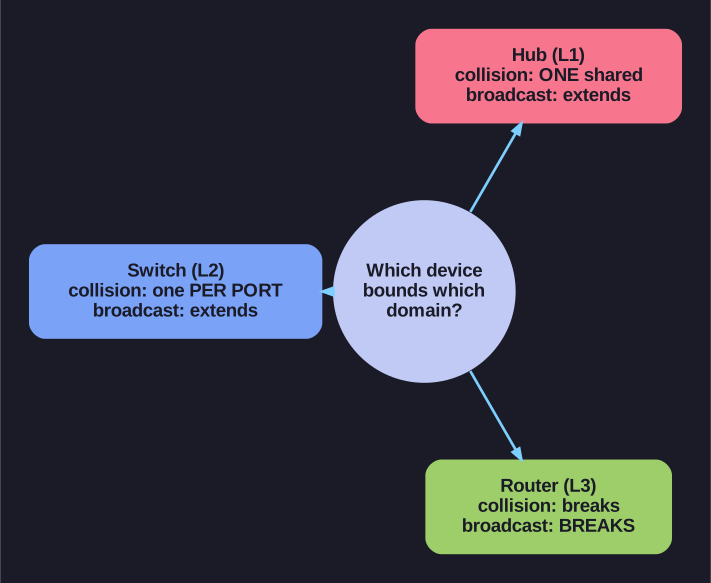
* Which device bounds which domain. *
| Dimension | Collision domain | Broadcast domain |
|---|---|---|
| What it scopes | Where two simultaneous transmissions collide | Where a broadcast frame (FF:FF:FF:FF:FF:FF) reaches |
| Bounded by | Each switch port (and removed entirely by full-duplex) | Each router (Layer 3) interface — or a VLAN |
| Add a switch | Shrinks them — every port is its own collision domain | Extends it — the flood reaches more devices |
| Add a router | Breaks it up | Breaks it up |
The sentence that ties the whole module together: a switch breaks up collision domains but extends the broadcast domain; only a Layer 3 device (a router) breaks up both. That is why a flat, switch-only LAN (Local Area Network) can be collision-free yet still drown in broadcast traffic — nothing stops a broadcast until it reaches a routed boundary.
Tip: "Switches split collisions, routers split broadcasts." VLANs (Virtual Local Area Networks) are the Layer 2 exception — they carve one switch into several broadcast domains without needing a separate router.
Go deeper:
 Broadcast domain (Wikipedia) — contrasts the collision domain a switch removes against the broadcast domain only a router bounds.