Quiz Entry - updated: 2026.07.30
How do bitwise operators work at the bit level in C?
Bitwise operators (& | ~ ^ << >>) work bit-by-bit on any integer type: AND keeps bits set in both, OR sets bits set in either, XOR sets bits that differ, and NOT flips every bit.
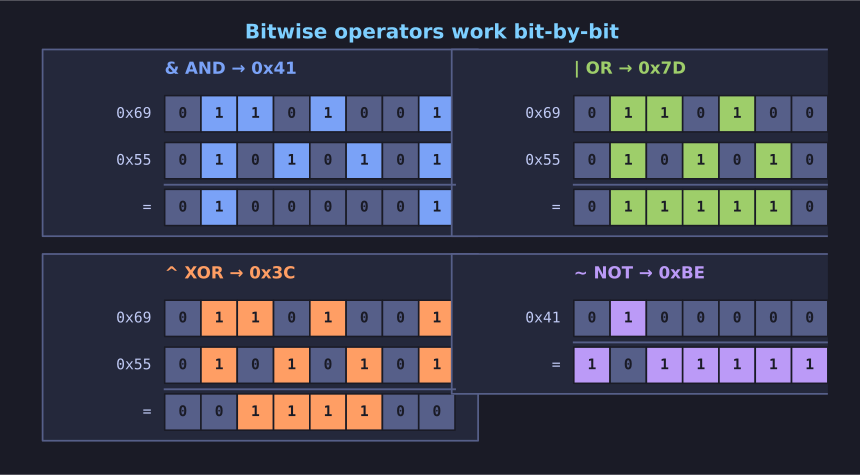
* AND keeps the common 1-bits, OR sets either operand's 1-bits, XOR sets the differing bits, and NOT flips them all — shown on 0x69 and 0x55. *
Operations: & | ~ ^ << >>
NOT (~) - Flip all bits:
~0x41  →  0xBE
~01000001₂  →  10111110₂

~0x00  →  0xFF
~00000000₂  →  11111111₂
AND (&) - Both bits must be 1:
0x69 & 0x55  →  0x41
01101001₂ & 01010101₂  →  01000001₂
OR (|) - Either bit can be 1:
0x69 | 0x55  →  0x7D
01101001₂ | 01010101₂  →  01111101₂
XOR (^) - Exactly one bit must be 1:
0x69 ^ 0x55  →  0x3C
01101001₂ ^ 01010101₂  →  00111100₂
Common uses:
- Masking:
value & 0xFFextracts lowest byte - Setting bits:
flags | FLAG_BIT - Clearing bits:
flags & ~FLAG_BIT - Toggling bits:
flags ^ FLAG_BIT - Checking bits:
if (flags & FLAG_BIT)
Go deeper:
 Bitwise operation — Wikipedia — AND/OR/XOR/NOT, shifts, and rotations.