Quiz Entry - updated: 2026.07.30
How do classic RFID and NFC compare in frequency, range, and security?
NFC is a high-frequency (13.56 MHz) subset of RFID with ~10 cm range and strong crypto; classic low-frequency RFID (125 kHz) reaches ~15 cm but uses simple protocols and little security.
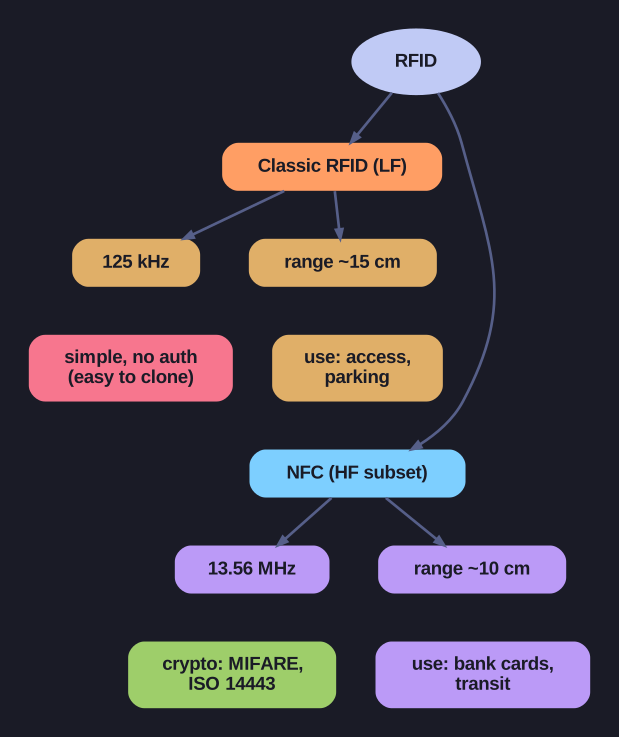
* Classic LF RFID versus its NFC subset — LF has longer range but no authentication. *
NFC is a subcategory of RFID (the high-frequency, 13.56 MHz variant).
| Classic RFID (LF) | NFC (HF) | |
|---|---|---|
| Frequency | 125 kHz (low) | 13.56 MHz (high) |
| Range | up to ~15 cm | up to ~10 cm |
| Protocols | simple, low security | complex, high security (MIFARE, ISO 14443) |
| Auth | tags send ID typically without authentication | supports crypto |
| Robustness | more robust around metal & liquids | up to 424 kbps data rate |
| Typical use | building access, parking systems | bank cards, public transit |
Tip: Counter-intuitively, the lower-frequency RFID has the longer range here — and "longer range + no authentication" is exactly why old 125 kHz access cards are easy to clone.
Go deeper:
 Radio-frequency identification (Wikipedia) — frequency bands, range and security across RFID classes.
- Near-field communication (Wikipedia) — the 13.56 MHz, short-range, higher-security RFID subset.