How do dynamic routing protocol routes appear in the routing table, and what do the numbers in brackets mean?
Dynamic routes are learned from routing protocols (OSPF (Open Shortest Path First), EIGRP (Enhanced Interior Gateway Routing Protocol), RIP (Routing Information Protocol), BGP) and show with codes like O, D, R, B. The numbers in brackets are [Administrative Distance (AD)/Metric] — AD determines trustworthiness, metric determines best path within one protocol.
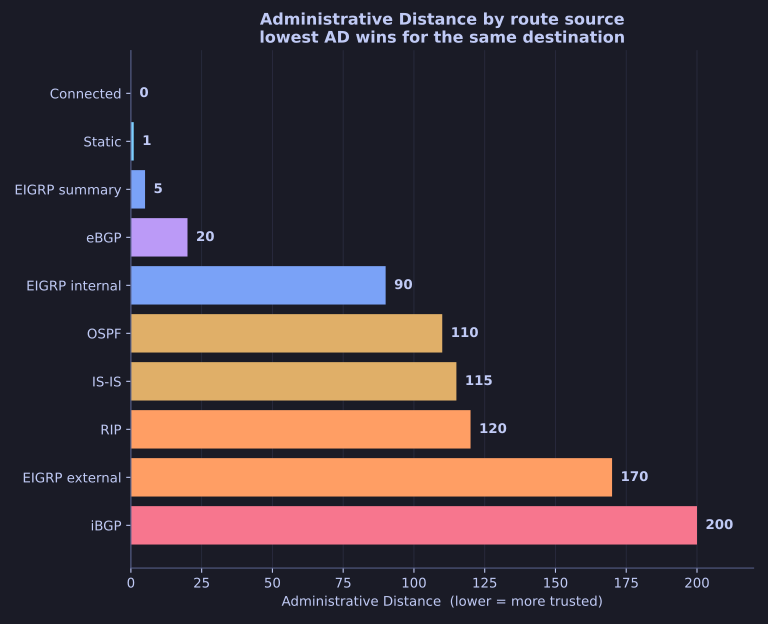
* Administrative distance by route source. *
Example OSPF routes:
O 10.0.4.0/24 [110/50] via 10.0.3.2, 00:24:22, Serial0/1/1
O 10.0.5.0/24 [110/50] via 10.0.3.2, 00:24:15, Serial0/1/1
Reading the format: [AD/Metric] via next-hop, age, exit-interface
| Field | Meaning | Example |
|---|---|---|
| O | Route source code (OSPF) | Learned via OSPF |
| 10.0.4.0/24 | Destination network and prefix | Target network |
| [110/50] | [Administrative Distance / Metric] | AD=110 (OSPF default), Metric=50 (OSPF cost) |
| via 10.0.3.2 | Next-hop IP (Internet Protocol) address | Send packets here |
| 00:24:22 | How long ago the route was learned | Route age |
| Serial0/1/1 | Exit interface | Send out this interface |
Administrative Distance (AD) — route trustworthiness:
| Route Source | AD | More Trusted ↑ |
|---|---|---|
| Directly connected | 0 | ← Most trusted |
| Static route | 1 | |
| EIGRP summary | 5 | |
| External BGP | 20 | |
| Internal EIGRP | 90 | |
| OSPF | 110 | |
| IS-IS | 115 | |
| RIP | 120 | |
| External EIGRP | 170 | |
| Internal BGP | 200 | ← Least trusted |
Key rule: When multiple routing sources know a route to the same destination, the route with the lowest AD is installed in the routing table. The other routes are hidden (but remembered — they activate if the preferred route disappears).
Go deeper:
 Administrative distance (Wikipedia) — explains the first bracket value and per-protocol AD defaults (OSPF 110, RIP 120…).