Quiz Entry - updated: 2026.07.30
How do HSRP and VRRP compare in terms of terminology and features?
HSRP (Hot Standby Router Protocol) and VRRP (Virtual Router Redundancy Protocol) are functionally very similar — both provide active/standby gateway redundancy. The main difference is that HSRP is Cisco-proprietary while VRRP is an open standard (RFC 5798).
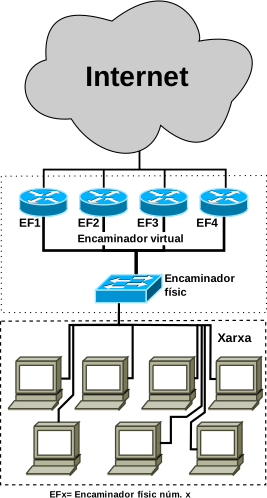
* VRRP master/backup virtual-router structure. — Papapep, CC BY-SA 4.0, via Wikimedia Commons. *
| Feature | HSRP | VRRP |
|---|---|---|
| Standard | Cisco-proprietary | Open standard (RFC 5798) |
| Terminology: Forwarding router | Active | Master |
| Terminology: Backup router | Standby | Backup |
| Default priority | 100 | 100 |
| Priority range | 0-255 | 1-254 |
| Preemption | Disabled by default | Enabled by default |
| Virtual IP (Internet Protocol) | Must be different from any interface IP | Can be the same as a physical interface IP |
| Virtual MAC (Media Access Control) format | 0000.0c07.acXX |
0000.5e00.01XX |
| IPv6 support | Separate protocol (HSRP for IPv6) | Built into VRRPv3 |
| Multicast address | 224.0.0.2 (v1) / 224.0.0.102 (v2) | 224.0.0.18 |
| Multi-vendor | No | Yes |
Key behavioral differences:
- VRRP has preemption enabled by default — if a higher-priority router comes online, it immediately takes over. HSRP requires you to explicitly enable
standby preempt - In VRRP, the master router's real interface IP can serve as the virtual IP — meaning you can have one router as the "IP address owner" which always preempts regardless of priority
- VRRP uses the term "master" instead of "active" — they mean the same thing
When to use VRRP over HSRP:
- Multi-vendor environments (the primary use case)
- When you need a standards-based solution for compliance
- VRRPv3 is preferred over VRRPv2 for IPv6 support
Go deeper:
 Virtual Router Redundancy Protocol (Wikipedia) — the open-standard counterpart to HSRP, with virtual-router roles and the 00-00-5E-00-01-XX MAC.
- RFC 5798 — VRRPv3 — canonical spec: priority election (owner=255, default=100) and IPv4/IPv6 virtual MACs.