How do quantum computers affect the security of block ciphers compared to asymmetric algorithms?
Quantum computers reduce block cipher brute-force from $2^n$ to $2^{n/2}$ (Grover's algorithm), which is serious but manageable — just double the key size. Asymmetric crypto is much harder hit.
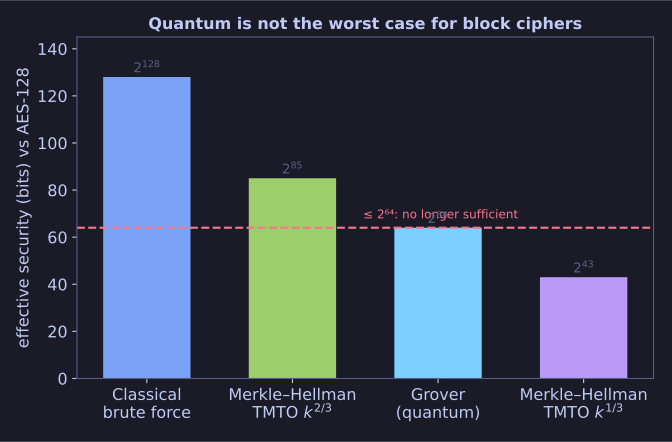
* Effective security of AES-128 under each attack — the theoretical classical TMTO ($2^{43}$) is even stronger than Grover ($2^{64}$). *
Impact comparison:
| Attack Type | Classical | Quantum |
|---|---|---|
| Brute Force on AES-128 | $2^{128}$ | $2^{64}$ (Grover) |
| Merkle-Hellman TMTO ($k^{2/3}$) | $2^{85}$ | — |
| Merkle-Hellman ($k^{1/3}$) | $2^{43}$ | — |
Grover's algorithm effectively halves the key length: AES-128 becomes 64-bit security under quantum attack → no longer sufficient.
Solution: Use AES-256, which provides $2^{128}$ security even against quantum computers — still perfectly safe.
Asymmetric crypto is in worse shape:
- Shor's algorithm breaks RSA, DH, and ECC completely (polynomial time)
- This is why post-quantum cryptography (new algorithms resistant to quantum attacks) is being developed
- Block ciphers are much more resilient against quantum computers than asymmetric schemes
Key takeaway: Block ciphers are relatively quantum-resistant — just double the key size. Asymmetric crypto needs entirely new algorithms.
Go deeper:
 Grover's algorithm (Wikipedia) — the quadratic speedup that halves effective key length.