How do Router Solicitation (RS) and Router Advertisement (RA) messages support dynamic IPv6 addressing?
A host that just booted sends an RS asking how to get IPv6 addressing; an IPv6 router replies with an RA carrying the prefix, prefix length, DNS, etc. With SLAAC the host builds its own address and uses the router's link-local address as its default gateway.
Router Solicitation (RS) and Router Advertisement (RA) are ICMPv6 messages that let a host configure its IPv6 settings dynamically, without a server having to hand out addresses one by one. The exchange replaces the role that DHCP plays in IPv4: instead of leasing a specific address, the router broadcasts the rules a host needs to build or request its own address.
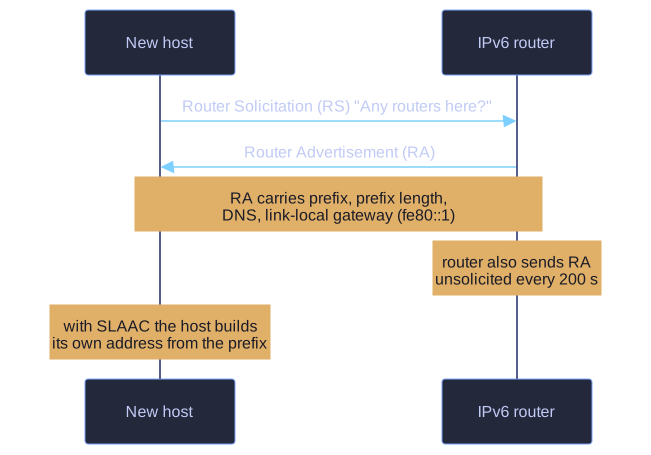
* The host asks with an RS; the router answers with an RA carrying the prefix and link-local gateway, so the host can build its own address via SLAAC. *
- A newly started host sends an RS message: "Is there an IPv6 router on the network? I need to know how to get my IPv6 address information dynamically."
- An IPv6-enabled router replies with an RA message advertising how to obtain addressing — for example, "Use SLAAC to create a global unicast address; the prefix is
2001:db8:acad:1::/64; use my link-local addressfe80::1as your default gateway."
Routers also send RA messages unsolicited every 200 seconds, so even a host that never sends an RS eventually learns the prefix; the RS just lets a host that boots mid-cycle get answers immediately instead of waiting up to 200 seconds. Each RA can carry the prefix, prefix length, DNS address, and domain name — everything the host needs to be reachable and to resolve names.
A host using Stateless Address Autoconfiguration (SLAAC) sets its default gateway to the link-local address (fe80::/10) of the router that sent the RA, not the router's global address. This works because the link-local address is guaranteed present on every IPv6 interface and never changes even if the global prefix is renumbered, so the gateway pointer stays valid.
Go deeper:
 RFC 4861 — Neighbor Discovery for IP version 6 (IPv6) — the authoritative description of Router Solicitation and Router Advertisement behaviour.
- Neighbor Discovery Protocol — Wikipedia — RS/RA in the context of SLAAC and stateless autoconfiguration.