How do the four main malware types — viruses, worms, trojans, and ransomware — differ from each other?
All are "software with harmful functions," but they differ in how they spread and what they do: a virus rides a host program, a worm spreads on its own, a trojan hides in a useful-looking app, and ransomware locks your data for money.
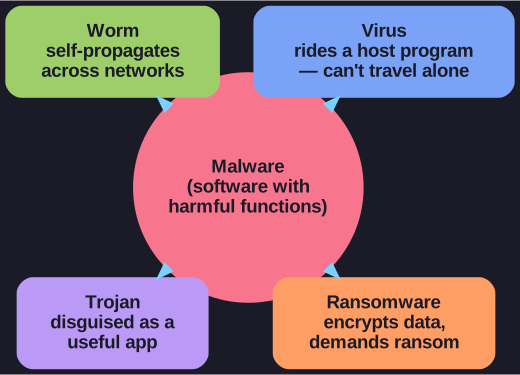
* All four are "malware," but each is defined by a different trait — how it travels or what it does. *
| Type | What it is | The distinguishing trait |
|---|---|---|
| Virus | Code that infects files and damages data (deletes work, photos, invoices) | Needs a host program to attach to and be carried along — it can't travel on its own |
| Worm | Self-propagating malware | Spreads without a host, copying itself across networks — which is how a single worm can paralyse worldwide networks |
| Trojan | Malware disguised as a harmless, useful application | Relies on deception: the user runs it willingly, while it secretly logs passwords, alters/deletes data, or eavesdrops via mic/webcam |
| Ransomware | Malware that encrypts your data or whole system | Adds an extortion step — it demands a ransom for the decryption key (which you may or may not actually get back) |
The unifying idea: the first three are mainly about how the code gets in and runs (carried, self-spreading, or tricked in), while ransomware is defined by its business model — denying you access to your own data and selling it back.
Tip: "Virus" gets used loosely for all malware, but precisely it's the one that needs a host. The category that matters most for awareness is the trojan, because it weaponises your trust — no exploit needed, just a convincing disguise.
Go deeper:
 Malware — Wikipedia — the parent category, with each type broken out.
- Ransomware — Wikipedia — the extortion-driven type covered in depth.