How do the signaling and data protocol stacks differ in a 2.5G network, and where does NAT happen?
Signaling stacks the MM Location Update (phone side) onto MAP Update Location (core side); the data path carries the phone's actual IP packets through GPRS tunnels, with NAT applied at the internet edge.
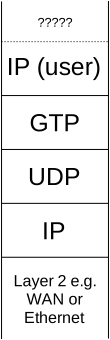
* User IP tunneled inside GTP over the GPRS core. — Stannered, CC BY-SA 3.0, via Wikimedia Commons. *
Signaling stack (registration):
- Phone side: the MM Location Update rides over the radio protocols to the MSC
- Core side: the MSC translates into MAP Update Location toward the HLR (over SS7)
- Two different protocol worlds, glued together at the MSC
Data stack (2.5G GPRS traffic flow):
- The smartphone's actual IP data for the internet is encapsulated and carried through the GPRS core (via SGSN and GGSN)
- At the edge to the internet, NAT translates the phone's (private) address — the same pattern still used in LTE at the P-GW
Why see it in Wireshark: Captured traffic from a real mobile network shows these layers stacked: the user's HTTP packet sitting inside GPRS tunneling, next to MAP signaling — making the invisible architecture suddenly concrete. A PCAP from a real network is the best way to internalize that "mobile data" is ordinary IP wrapped in a very particular set of envelopes.
Tip: Keep the two planes separate in your head: signaling (MM/MAP — who you are, where you are) never mixes with user data (IP in tunnels) — they just share the same radio.
Go deeper:
 Harald Welte — What happens on a protocol level when I switch on my phone? (CCC, 2018) — shows the signaling and data stacks side by side in real captured traffic, making concrete that "mobile data" is ordinary IP wrapped in GPRS tunnels next to MAP signaling.