How do the threads of a critical-thinking practice — defining problems, vetting sources, checking your own bias, and questioning AI — hang together as one habit rather than separate tricks?
They're all the same move pointed in different directions: refusing to wave a claim through unexamined — whether the claim comes from a problem statement, a source, your own head, or a machine.
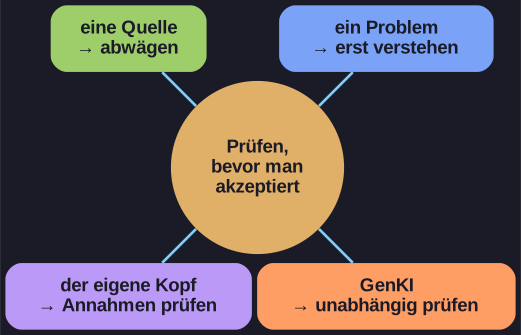
* Four different inputs, one shared move at the centre: examine the claim before you accept it. *
A critical thinker runs one underlying loop against every input:
| Where the claim comes from | The unexamined trap | The critical move |
|---|---|---|
| A problem you face | Jumping to a solution | Frame what's really happening and why first |
| A source | Believing the convenient one | Weigh reliability, age, informativeness; seek opposing views |
| Your own mind | Trusting your first conclusion | Surface your assumptions and blind spots before settling |
| Generative AI | Mistaking fluency for truth | Treat plausibility as zero evidence; verify independently |
The unifying idea is responsibility for what you accept and pass on: sloppy reasoning spreads, so the discipline is partly ethical, not just a skill. Creativity (imagining what's possible) and critical thinking (judging what's true) are the complementary halves — you need both, and both only matter once you act on them.
Tip: When stuck, ask the universal question behind all four rows: "What would have to be true for this to be right, and have I actually checked it?"
Go deeper:
 Divergent thinking — the creativity half of the pair: generating many possibilities, the complement to critical thinking's job of judging which ones hold up.