How do the three smart-fridge alternatives compare on usability, effort and security, and why is A2 (no network at all) preferred?
A1 (via proxy into the internet) and A3 (in the DMZ) both score best on usability but cost a lot of effort, and both are weak on security (A1 worse than A3). A2 keeps the fridge isolated without a network: usability drops to the local touchscreen and there is no remote access, but effort is low and security is very high. A2 is preferred because its IT security risk is the lowest.
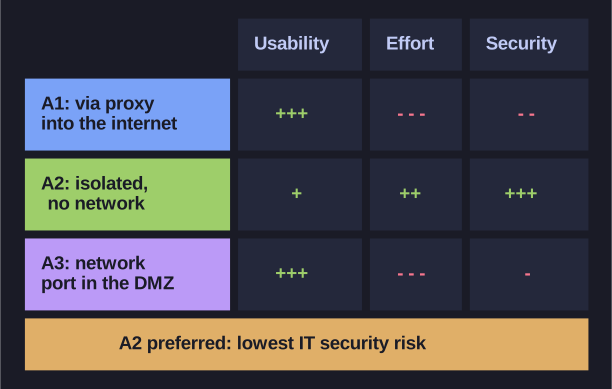
* Plus is favourable and minus unfavourable in every row, so "effort ++" means little effort. *
The set-up: a cheese dairy's kitchen chef has bought a smart fridge (F-2000i) whose app features need internet access. Three ways to handle it were collected:
- A1: fridge in the workplace LAN, out to the vendor through the web proxy.
- A2: fridge isolated, no network port at all.
- A3: fridge with a network port in the DMZ.
A2 in detail. Pro: very secure because there is no network, complete isolation, and a minimised IT security risk. Con: no remote access, so the app features and alarms on the phone are lost. The fridge still cools and can be operated at its touchscreen, which is all the kitchen needed when the old fridge broke.
| A1: via proxy | A2: isolated | A3: in the DMZ | |
|---|---|---|---|
| Usability | +++ | + | +++ |
| Effort | --- | ++ | --- |
| Security | -- | +++ | - |
This is one of the special cases where security-by-isolation is the right call: the system does not need the interaction that isolation cuts off, and the convenience lost is small compared with the risk avoided.
Go deeper:
 Attack surface — Wikipedia — why removing an interface removes risk in a way no control on it can.
- NIST SP 800-30 Rev. 1 — Guide for Conducting Risk Assessments — weighing likelihood and impact to compare options like these.