Quiz Entry - updated: 2026.07.30
How do Tor (Onion Routing) and I2P compare in goal, path structure, and typical use?
Tor is optimised for anonymously reaching the normal Internet through random onion circuits; I2P is a closed peer-to-peer network optimised for anonymous services inside I2P.
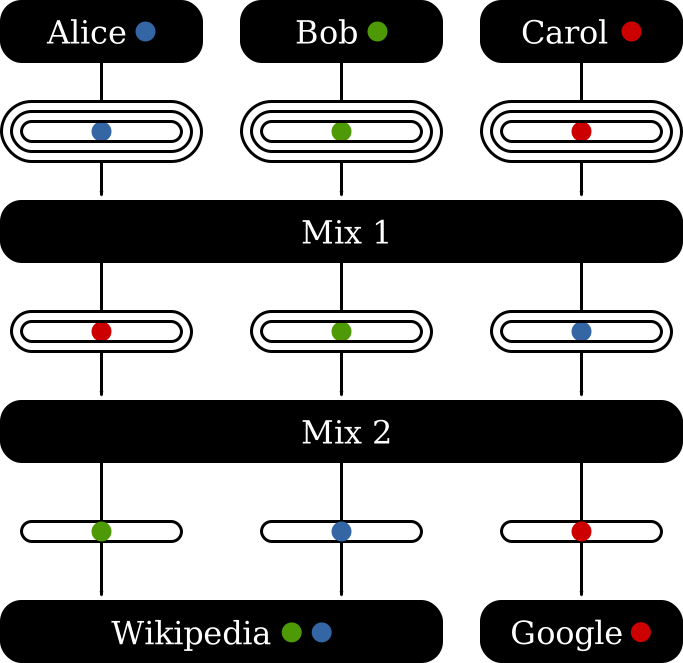
* A mix node shuffling traffic to break sender linkage. — Bananenfalter, CC0, via Wikimedia Commons. *
| Aspect | Tor (Onion Routing) | I2P |
|---|---|---|
| Goal | Anonymity via layered encryption, reach the clearnet | Anonymity inside a closed P2P network |
| Path | Random encrypted circuit of onion hops | Every node is also a relay (P2P) |
| Encryption | Layered; each hop strips one layer | Garlic routing: layered + message bundling |
| Node knowledge | Each node knows only previous + next hop | Each client acts as sender, receiver, and relay |
| Typical use | Browsing the normal web, darknet, whistleblowing | Eepsites, anonymous file sharing, I2P-mail |
The practical split: use Tor to anonymously visit ordinary websites (and .onion sites); use I2P for anonymous hidden services and P2P communication that never need to touch the clearnet.
Tip: Tor is a door to the Internet; I2P is a self-contained anonymous city.
Go deeper:
 I2P (Wikipedia) — the closed-network counterpart for the side-by-side comparison.
- Mix network (Wikipedia) — background on the anonymity-network family both descend from.