Quiz Entry - updated: 2026.07.30
How do Wireless PAN, LAN, ad-hoc, and cellular networks differ?
They differ primarily in range, data rate, and whether they require infrastructure.
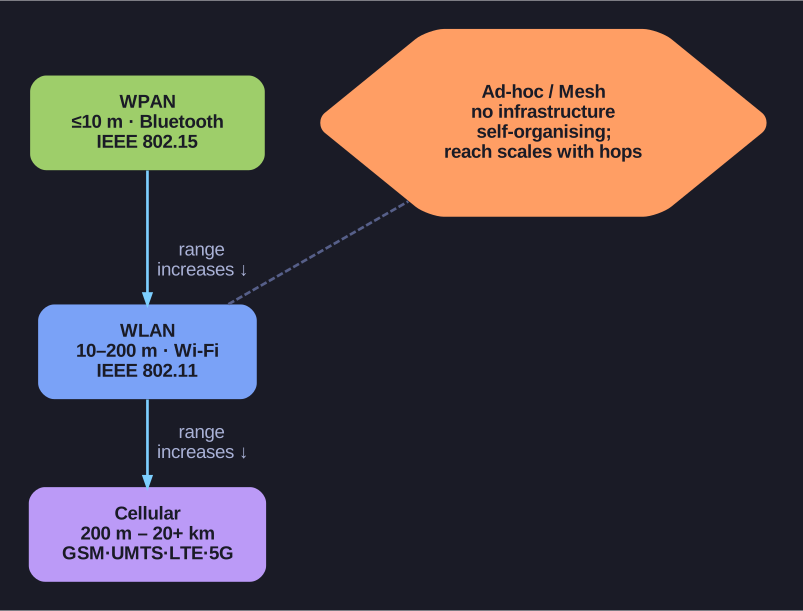
* Range grows PAN → WLAN → cellular; ad-hoc/mesh is orthogonal (no infrastructure). *
Wireless PAN (Personal Area Network):
- Range: within a person's reach, typically under 10 meters.
- Example: Bluetooth connecting your phone to headphones or a smartwatch.
- Low power, low data rate, designed for personal device ecosystems.
- Standard: IEEE 802.15.
Wireless LAN (Local Area Network):
- Range: 10-200 meters (indoor to outdoor).
- Connects two or more devices over short distances wirelessly.
- Example: Wi-Fi in your home, office, or coffee shop.
- Standard: IEEE 802.11 (a/b/g/n/ac/ax).
Wireless Ad-hoc Network (Mesh):
- No fixed infrastructure. Radio nodes self-organize into a mesh topology.
- Each node can relay traffic for others.
- Range depends on how many nodes can relay.
- Used in military, emergency response, and IoT sensor networks.
Cellular / Mobile Network (Mobilfunk):
- A radio network distributed over large areas using cells, each served by at least one fixed transceiver (base station).
- Range: 200m to 20+ km per cell.
- The cells tessellate to provide seamless coverage over entire countries.
- Standards: GSM, UMTS, LTE, 5G NR.
Tip: Think of it as a range spectrum. PAN covers your body, LAN covers your building, cellular covers your country.
Go deeper:
 Cellular network (Wikipedia) — the longest-range family: how tessellating cells with frequency reuse scale coverage to a whole country.