Quiz Entry - updated: 2026.07.30
How do you declare a reference in C++?
Type& name = variable; creates an alias — a second name for an existing variable.
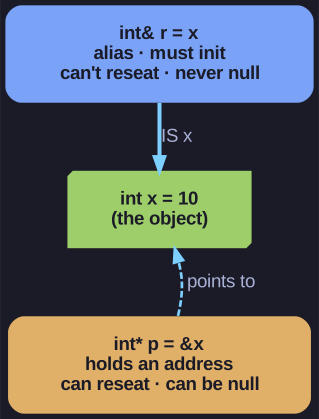
* A reference is the object under another name (must be bound at birth, never reseated, never null); a pointer merely holds its address. *
int x = 10;
int& ref = x;    // ref is now another name for x

ref = 20;        // changes x to 20
cout << x;       // prints 20
Key differences from pointers:
| Reference | Pointer |
|---|---|
| Must be initialized at declaration | Can be nullptr |
| Can't be reseated to another variable | Can point elsewhere |
| Used like the value itself | Needs * to dereference |
ref = 5 changes the referent |
*ptr = 5 changes the pointee |
Common use — pass by reference:
void swap(int& a, int& b) {
    int temp = a;
    a = b;
    b = temp;
}
Tip: A reference is like a pointer that's always valid and auto-dereferenced — cleaner to use, but less flexible (you can't reseat it or make it null).
Go deeper:
 Reference declaration — cppreference — lvalue and rvalue reference rules.
- Reference (C++) — Wikipedia — references contrasted with pointers.