How does 5G separate the control plane from the user plane, and what does "cloudification" of the core mean?
Control-plane functions (AMF, SMF) are often run in the cloud, while the user plane (UPF) is kept simple and localised — giving lower latency and higher speed. Cloudification means the core is built from disaggregated, virtualised, commercialised software functions running elastically on commodity cloud data centres.
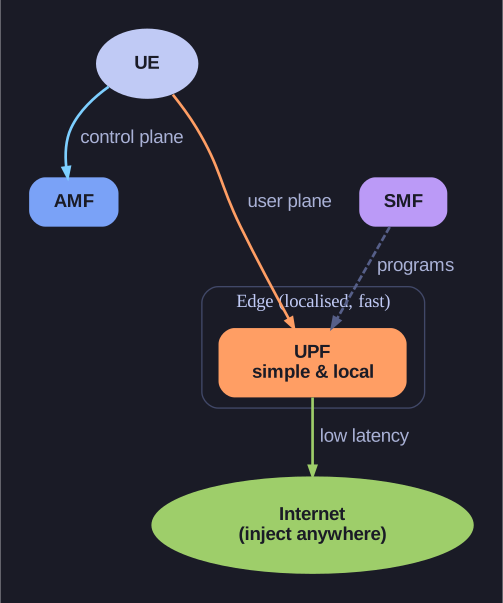
* Control plane to the cloud, user plane (UPF) to the edge. *
Control/user-plane separation in 5G:
- Control-plane components (AMF, SMF) are often run in the cloud — centralised, scalable
- The user plane (UPF) is kept simple and localised → lower latency and higher speed
- "Localised" means data can be injected into the internet anywhere in the world — the strict "home network" principle is softened (your data needn't always route home)
Cloudification of the core — the cloud changed computing through three properties, now applied to the network:
- Disaggregation: breaking integrated systems into independent components with open interfaces
- Virtualisation: running multiple independent copies of these components on a shared hardware platform
- Commercialisation/commoditisation: scaling these virtual components elastically across commodity data centres according to workload
The result: the cloudification of the core network keeps advancing — there are already numerous vendors offering and operating core-network functions in the cloud (e.g., on AWS).
Tip: Control plane → cloud (centralised intelligence); user plane → edge (localised, fast). Putting the UPF close to the user is exactly how 5G achieves low latency — the data doesn't detour to a distant core.
Go deeper:
 Network function virtualization (Wikipedia) — running NFs as software on COTS servers instead of bespoke appliances, decoupling function from hardware.