How does a compiler translate traversing a linked list (following r = r->n until NULL) into assembly?
As a while (r != NULL) loop: load fields by their struct offsets, then load the next pointer and test it against itself to detect NULL.
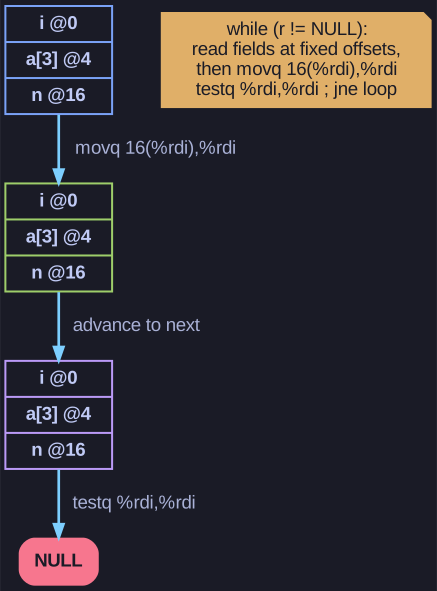
* movq 16(%rdi),%rdi advances to the next node; testq %rdi,%rdi ; jne loops until the NULL pointer. *
A linked list walk is just a loop whose update step is "follow a pointer." Each iteration reads fields at fixed offsets, then replaces the current pointer with the node's next field:
struct rec { int i; int a[3]; struct rec *n; };  // n at offset 16

void set_val(struct rec *r, int val) {
    while (r != NULL) {
        int i = r->i;
        r->a[i] = val;
        r = r->n;
    }
}
Assembly (guarded do-while, as compilers emit while-loops):
set_val:
    jmp     .L7                          # jump to the guard test first
.L5:
    movslq  (%rdi), %rax                 # rax = r->i      (offset 0)
    movl    %esi, 4(%rdi,%rax,4)         # r->a[i] = val   (a at offset 4)
    movq    16(%rdi), %rdi               # r = r->n        (next at offset 16)
.L7:
    testq   %rdi, %rdi                   # is r NULL?
    jne     .L5                          # if not, loop again
    rep ret
What to recognize: the movq 16(%rdi), %rdi that overwrites the base pointer with a value loaded from that struct is the signature of "advance to next node," and testq %reg,%reg ; jne is the NULL-terminated loop condition.
Go deeper:
 Linked list (Wikipedia) — the linked list data structure.