Quiz Entry - updated: 2026.07.30
How does a DHCP (Dynamic Host Configuration Protocol) client renew its lease before it expires?
The client sends a DHCPREQUEST directly (unicast) to the original server, which responds with a DHCPACK.
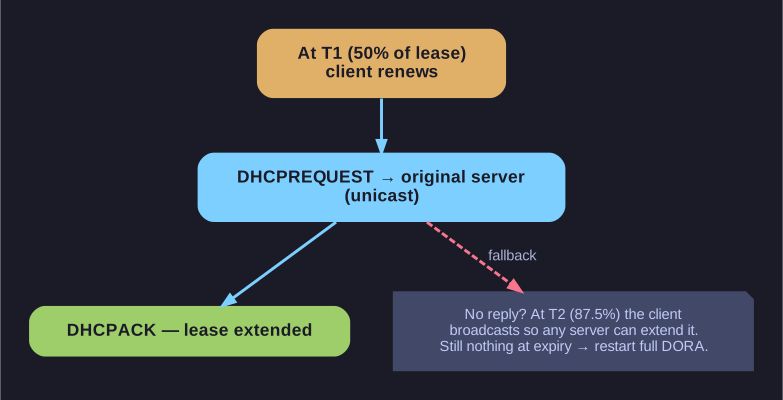
* DHCPv4 lease renewal — T1 renew, T2 rebind, then full DORA (Discover, Offer, Request, Acknowledge). *
Renewal process (only 2 steps):
- DHCPREQUEST — Before the lease expires, the client sends a unicast request directly to the DHCPv4 server that originally assigned the address
- DHCPACK — The server verifies the lease and confirms the renewal
Key details:
- The renewal is unicast (not broadcast) because the client already knows the server's IP (Internet Protocol)
- If the original server doesn't respond, the client broadcasts a DHCPREQUEST so any DHCP server can extend the lease
- If no server responds before the lease expires, the client must start the full DORA process again
- Clients typically attempt renewal at 50% of the lease time (T1 timer) and again at 87.5% (T2 timer)
Tip: Initial lease = 4-step DORA (broadcast). Renewal = 2-step shortcut (unicast). The client only falls back to broadcast if the original server is unreachable.
Go deeper:
 DHCP — renewal (Wikipedia) — the unicast renew at half the lease, then the broadcast rebind fallback.
- RFC 2131 §4.4.5 — Reacquisition and expiration — the T1 (RENEWING) and T2 (REBINDING) timers and unicast→broadcast escalation.