How does a pin-tumbler cylinder lock actually open when the correct key is inserted?
The cylinder has a plug that wants to rotate inside a housing, blocked by spring-loaded pin stacks crossing the shear line. The right key pushes each pin stack to a height where the gap between the upper (driver) pin and lower (key) pin sits exactly at the shear line — the plug is now free to rotate.
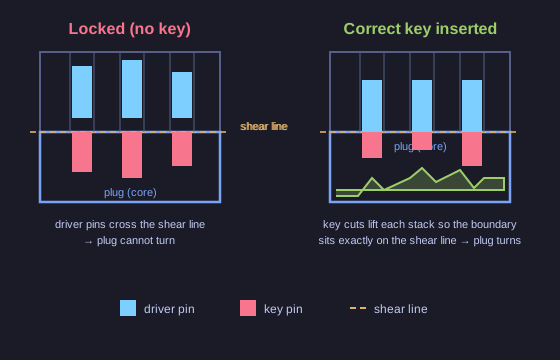
* Pin-tumbler cylinder — locked (driver pins cross the shear line) vs. correct key inserted (each boundary meets the shear line, plug turns). *
The structure of one pin stack: a spring at the top pushes the stack down; below it sits the driver pin (top, fixed length), then the key pin (bottom, length varies per cut). The shear line is the boundary between the plug and the surrounding housing.
Locked state:
- Spring pushes the stack down → driver pin straddles the shear line → plug can't rotate.
Correct key inserted:
- Each cut on the key lifts its pin stack by a different amount.
- For every stack, the boundary between driver and key pin lands exactly on the shear line.
- The plug is now free of all obstructions → rotates → cam at the back retracts the bolt.
Why a wrong key fails:
- Cuts too shallow → driver pin still in plug → blocks rotation.
- Cuts too deep → key pin crosses the shear line → blocks rotation from below.
- The key must be exactly right, not just "close enough" — this is what makes blanks impossible to use directly.
The exploitable physics:
Real cylinders have manufacturing tolerances — the plug isn't a perfect cylinder, the housing isn't a perfect bore. Apply slight rotational tension and one pin will bind against the shear line before the others. Push that one to height, and it sets — leaving the others to be tackled in turn. This is the entire basis of Single Pin Picking (SPP).
Tip: Look up "Visual Guide to Lock Picking" by Mark McCloud — the freely available PDF is the canonical introduction and a source of many lock-picking diagrams.
Go deeper:
 Pin tumbler lock — animated diagrams of the plug, driver/key pins, and the shear line, plus the spool/serrated security-pin variants.