How does a star topology (like a banking ATM network) reduce the number of symmetric keys needed?
With a central trusted server, each participant only needs one key shared with the server, reducing the total to $n$ keys instead of $\frac{n(n-1)}{2}$.
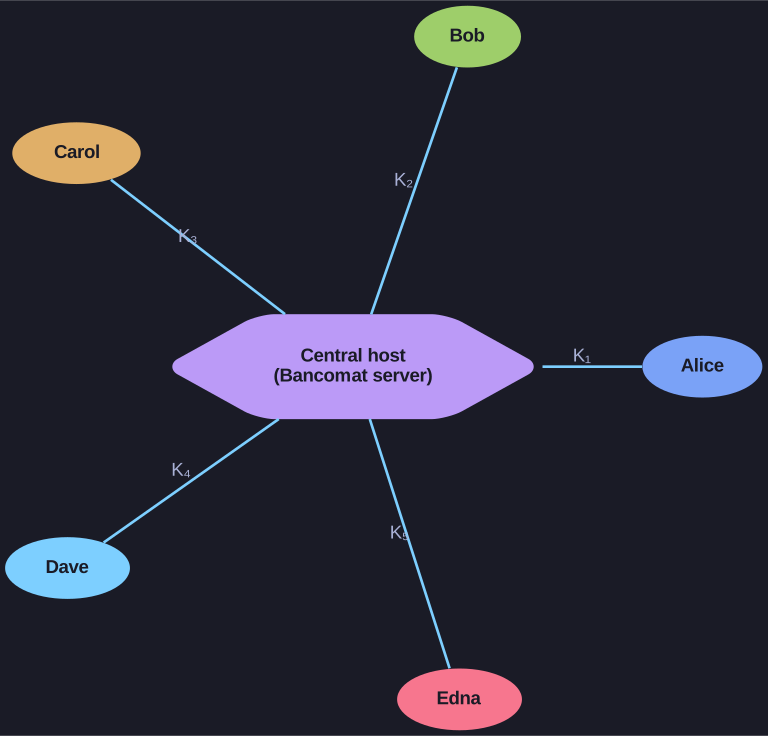
* Each terminal shares one key with the central host, so n keys instead of n(n-1)/2. *
In a star topology:
- A trusted central server (Zentrale) acts as intermediary
- Each of the $n$ participants shares exactly one key with the server
- Communication between A and B goes through the server
$$\text{Keys} = n \quad \text{(instead of } \frac{n(n-1)}{2}\text{)}$$
Real-world example: The Bancomat/ATM system. Your bank card shares a key with the bank's server. When you use an ATM, the ATM communicates with the central server — you don't need a separate key for each ATM.
Trade-off: The central server is a single point of failure and a high-value target. If compromised, all communications are compromised.