Quiz Entry - updated: 2026.10.26
How does an exhaustive key search (brute force) work, and what determines its computational cost?
An exhaustive key search is a known-plaintext attack that tries every possible key until the correct one is found — it costs $k$ operations where $k = 2^n$ for an n-bit key.
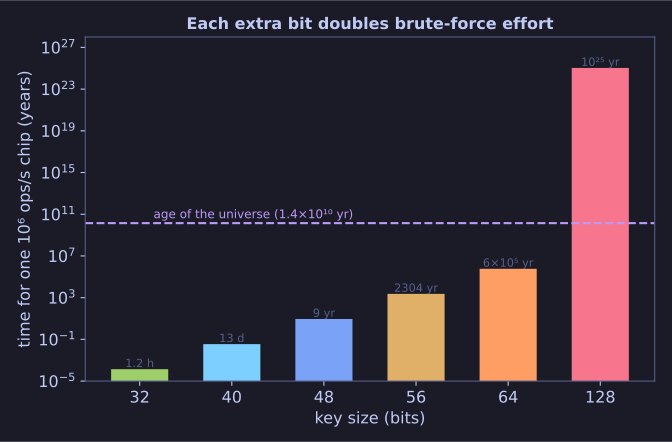
* Time to search the whole key space on a single $10^6$ ops/s chip — every extra bit doubles the effort. *
How it works:
- Obtain at least one known plaintext-ciphertext pair $(M, C)$
- For each possible key $K_i$: check if $E(M, K_i) = C$ or $D(C, K_i) = M$
- If match found → key discovered
Requirements:
- Key space size $k$ must equal $2^n$ (all keys equally likely, maximum entropy)
- On average, you find the key after testing k/2 keys
- Building a complete lookup table requires exactly k operations
Concrete brute-force times (1 million operations/sec per chip):
| Key Size | Key Space | 1 Chip | 1,000 Chips | 10 Million Chips |
|---|---|---|---|---|
| 32 bit | $4.3 \times 10^9$ | 1h 12min | 4.3 sec | — |
| 56 bit | $7.2 \times 10^{16}$ | 2,304 years | 2.3 years | ~2 hours |
| 64 bit | $1.8 \times 10^{19}$ | 600,000 years | 581 years | 22 days |
| 128 bit | $3.4 \times 10^{38}$ | $10^{25}$ years | $10^{22}$ years | $10^{18}$ years |
Key takeaway: Each additional bit doubles the brute-force effort. This exponential growth is why 128-bit and 256-bit keys are considered secure against brute force for the foreseeable future.
Go deeper:
 Brute-force attack (Wikipedia) — exhaustive key search and its theoretical limits.
- Key size (Wikipedia) — how many bits actually buy how much security.