Quiz Entry - updated: 2026.10.26
How does CBC (Cipher Block Chaining) mode work?
In CBC mode, each plaintext block is XOR'd with the previous ciphertext block before encryption, creating a chain where each block depends on all preceding blocks.
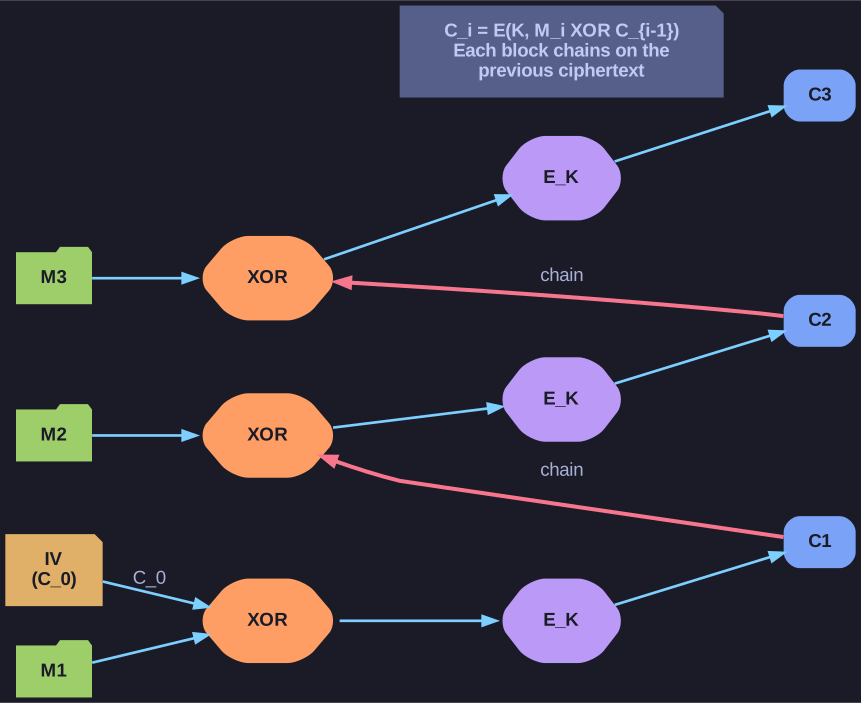
* CBC XORs each block onto the previous ciphertext block before encrypting, chaining every block forward. *
Encryption:
$$\begin{aligned} C_0 &= IV \quad\text{(Initialization Vector)} \\ C_i &= E(K, M_i \oplus C_{i-1}) \end{aligned}$$
Decryption:
$$M_i = D(K, C_i) \oplus C_{i-1}$$
Key properties:
- IV must be random and unpredictable for each message (but doesn't need to be secret)
- Identical plaintext blocks produce different ciphertext (because they're XOR'd with different previous blocks)
- A one-bit error in $C_i$ corrupts $M_i$ completely AND flips one bit in $M_{i+1}$ (error propagation limited to 2 blocks)
Encryption is sequential (each block depends on the previous), but decryption is parallelizable (each block only needs $C_{i-1}$).
CBC is the most widely used mode for file/disk encryption and was the default in TLS until 1.3.
Go deeper:
 Block cipher mode of operation (Wikipedia) — CBC chaining, the IV requirement, and error behaviour.