Quiz Entry - updated: 2026.07.30
How does challenge-response with symmetric cryptography authenticate a user without sending the password?
Both sides share a secret key. Server sends a random challenge; client returns HMAC(key, challenge); server verifies by computing the same HMAC.
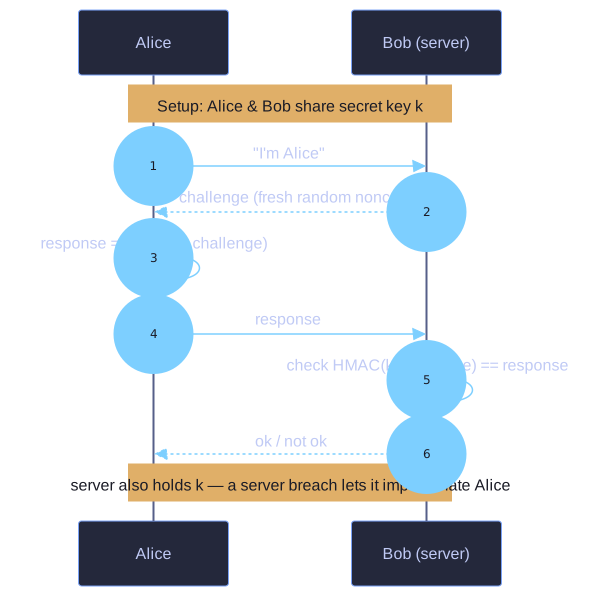
* A fresh challenge each session — the shared key never crosses the wire, but the server holds it too. *
The flow:
- Setup: Alice and Bob share the same symmetric key (out-of-band — e.g. during account creation).
- Login:
- Alice → Bob:
"I'm Alice" - Bob → Alice: random
challenge(a fresh nonce, e.g. 128 bits) - Alice → Bob:
response = HMAC(key, challenge) - Bob computes
HMAC(key, challenge)himself and checks it matches the response.
- Alice → Bob:
Why it's better than password-in-the-clear:
- The secret key never leaves either machine.
- The challenge is random per session → an eavesdropper sees a different exchange every time and can't replay it.
- Even if Eve captures the response, it's only valid for that one challenge.
Drawback to remember: Bob also has a copy of the key. If Bob's server is compromised, the attacker can impersonate Alice — they have the same key Alice has. That's why public-key challenge-response is often preferred for high-stakes systems.
Go deeper:
 Challenge–response authentication (Wikipedia) — nonces, HMAC responses, and the symmetric-vs-public-key trade-off.