Quiz Entry - updated: 2026.07.30
How does cut-through switching work, and what is the Fragment Free variant?
Cut-through starts forwarding a frame as soon as it reads the destination MAC (Media Access Control) address (the first 6-byte field after the preamble), without waiting for the rest of the frame. Fragment Free waits for the first 64 bytes to filter out collision fragments (runts).
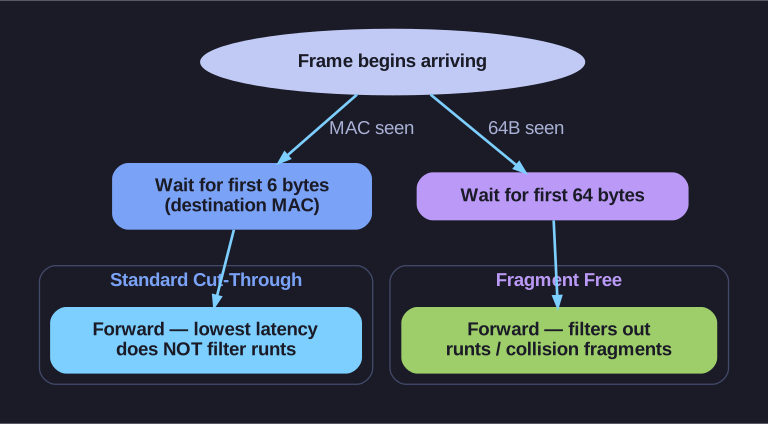
* Cut-through vs the Fragment Free variant. *
Standard Cut-Through:
- Reads only the destination MAC (the first 6-byte field of the frame, right after the preamble)
- Immediately looks up the egress port and begins forwarding
- The rest of the frame streams through while the beginning is already being sent out
Fragment Free (modified cut-through):
- Waits for the first 64 bytes before forwarding
- Why 64 bytes? Because Ethernet collisions can only corrupt frames shorter than 64 bytes (these are called runts)
- This filters out the most common type of error while still being faster than store-and-forward
Drawbacks of cut-through:
- No FCS (Frame Check Sequence) check → corrupt frames get forwarded, wasting bandwidth
- Cannot bridge speed mismatches → no buffering between different port speeds
- If error rates are high, cut-through can make congestion worse by propagating bad frames
Tip: Think of cut-through like forwarding a letter after just reading the address on the envelope — fast, but you have no idea if the contents are damaged.
Go deeper:
 Cut-through switching (Wikipedia) — forwarding before the full frame arrives, the store-and-forward contrast, and the 64-byte Fragment Free middle ground.