How does differential privacy protect data, and where is it used at scale?
It adds carefully calibrated mathematical noise so that including or excluding any single individual has negligible impact on the output — used famously by the US Census Bureau for the 2020 Census.
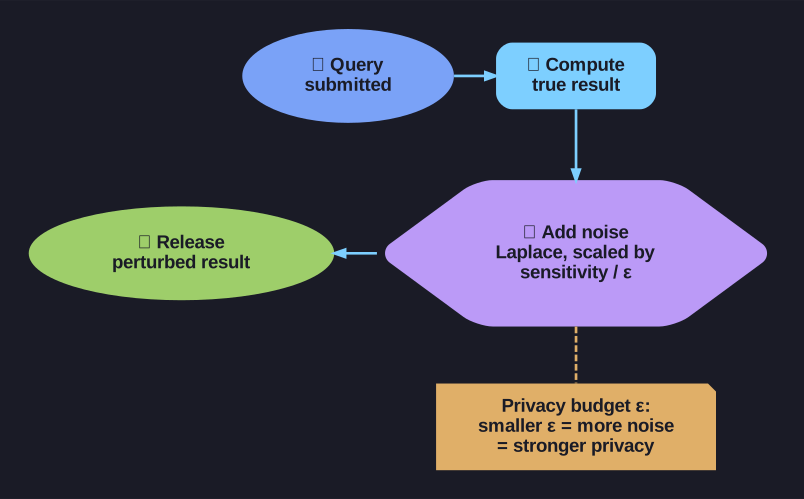
* The DP query mechanism: calibrated Laplace noise is added before release. *
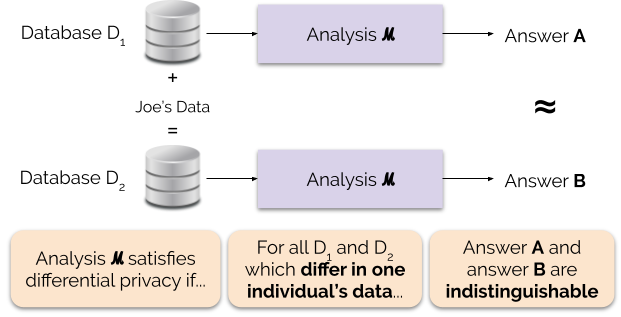
* Adding or removing one person barely changes the result. — Near, Darais & Boeckl, Public domain, via Wikimedia Commons. *
The process for a query:
- A query is submitted to the dataset.
- The true result is computed.
- Mathematical noise is added based on a privacy budget.
- The perturbed result is released.
The formal guarantee: an observer of the output essentially cannot tell whether any one person's data was in the dataset — so individuals get plausible deniability while aggregate statistics stay accurate.
The privacy budget (ε, epsilon): controls the noise/accuracy trade-off. Smaller ε = more noise = stronger privacy but less accuracy; every query "spends" from a finite budget.
Real deployment: the US Census 2020 adopted differential privacy — a landmark for privacy-preserving government data. Apple and Google also use it for telemetry.
Go deeper:
 Differential privacy (Wikipedia) — the epsilon definition, Laplace mechanism and Census/Apple/Google deployments.
- Dwork, "Differential Privacy" (ICALP 2006) — the foundational paper introducing the formal guarantee.