Quiz Entry - updated: 2026.07.30
How does GLBP differ from HSRP and VRRP, and why is it sometimes preferred?
GLBP (Gateway Load Balancing Protocol) is the only FHRP (First Hop Redundancy Protocol) that provides both redundancy AND load balancing. Unlike HSRP (Hot Standby Router Protocol)/VRRP (Virtual Router Redundancy Protocol) where only one router forwards, GLBP distributes traffic across multiple routers simultaneously.
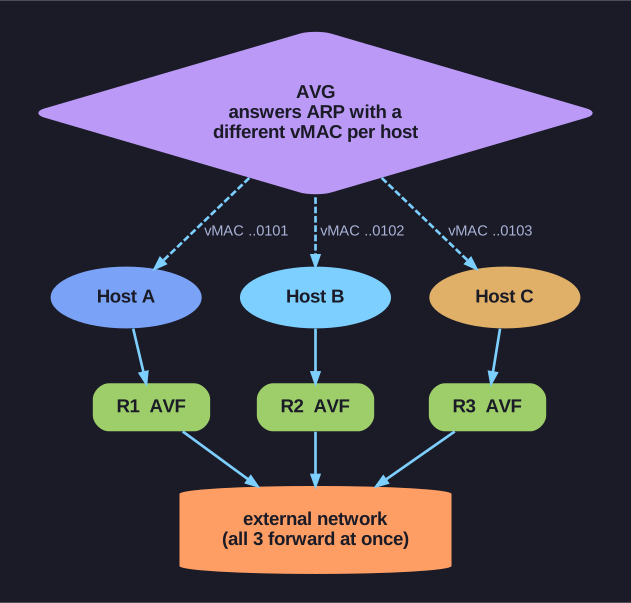
* GLBP load-sharing: the AVG hands each host a different virtual MAC so all forwarders carry traffic simultaneously. *
The HSRP/VRRP problem:
- Only the active router forwards traffic
- The standby router sits idle — its bandwidth and CPU are wasted during normal operation
- In a network with two equally capable routers, 50% of gateway capacity is unused
How GLBP solves this:
- One router is elected as the Active Virtual Gateway (AVG) — it manages the group
- The AVG assigns virtual MAC (Media Access Control) addresses to each router in the group (Active Virtual Forwarders, or AVFs)
- When hosts ARP (Address Resolution Protocol) for the gateway, the AVG responds with different virtual MACs for different hosts
- Each host sends traffic to its assigned MAC → the corresponding router forwards it
- Result: all routers in the group forward traffic simultaneously
Example with 3 routers:
- Host A gets MAC
0007.b400.0101→ Router 1 forwards - Host B gets MAC
0007.b400.0102→ Router 2 forwards - Host C gets MAC
0007.b400.0103→ Router 3 forwards
GLBP still provides failover:
- If any router fails, its traffic is redistributed to surviving routers
- Hosts don't need to update their ARP — the AVG simply stops assigning the failed router's MAC
When to choose GLBP over HSRP:
- When you want to utilize all routers' bandwidth simultaneously
- When you have multiple routers on the same VLAN (Virtual Local Area Network) and want to avoid waste
- Note: GLBP is Cisco-proprietary, so it only works in all-Cisco environments