Quiz Entry - updated: 2026.07.30
How does IPv6 tunneling carry traffic across an IPv4-only segment?
A tunnel entry router wraps the whole IPv6 packet inside an IPv4 packet, the IPv4 network forwards it to the tunnel exit router, which strips the IPv4 wrapper and continues as native IPv6.
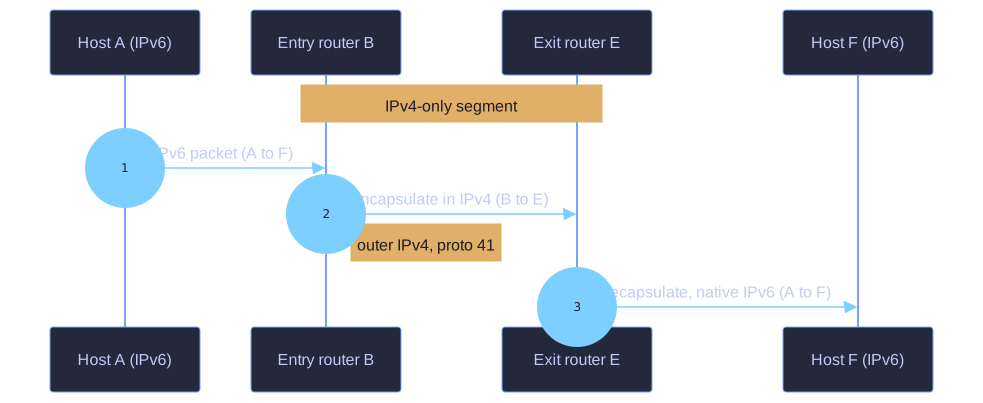
* 6in4: the entry router wraps IPv6 in IPv4, the exit router unwraps it. *
Picture a path A–B–C–D–E–F where the middle (C, D) is IPv4-only but the ends are IPv6:
- The IPv6 packet (
Source A → Dest F) reaches the tunnel entry router B - B encapsulates it inside an IPv4 packet addressed
Source B → Dest E(the tunnel endpoints) - The IPv4 network routes that packet normally from B to E
- The tunnel exit router E decapsulates it, recovering the original IPv6 packet
- The native IPv6 packet continues E → F
Logically B and E look directly connected ("IPv6 over IPv4 when needed"); physically it crossed IPv4 routers that never knew IPv6 was inside.
Tip: Tunneling = "IPv6 in an IPv4 envelope." Real-world examples include 6in4, 6to4, and Teredo.
Go deeper:
 6in4 (Wikipedia) — the canonical IPv6-in-IPv4 encapsulation, including IP protocol 41 and the 20-byte overhead.
- IPv6 transition mechanism (Wikipedia) — situates tunneling among 6to4, Teredo and tunnel brokers.