How does k-anonymity protect privacy, and what two operations achieve it?
k-anonymity makes each record indistinguishable from at least k-1 others on its quasi-identifiers — hiding everyone in a crowd — via generalization and suppression.
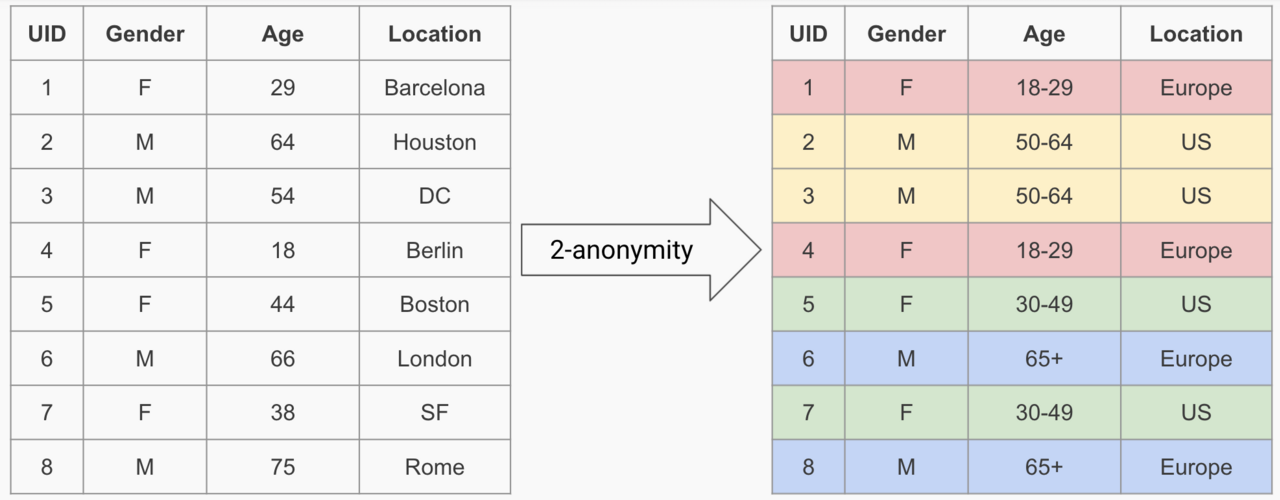
* Generalization turning records into 2-anonymous groups. — HTriedman (WMF), CC BY-SA 4.0, via Wikimedia Commons. *
The promise: if k=5, your record looks identical to 4 others on the QIDs, so an attacker who matches you faces 5 indistinguishable candidates and can't single you out. It delivers three things: group protection, prevents isolation (no unique standouts), and privacy through ambiguity (attackers can't tell group members apart).
Two operations build the equivalence classes:
- Generalization — replace a specific value with a broader category (Age 27 → 20–30; ZIP 94301 → 943**; salary 87,500 → 80k–90k band).
- Suppression — remove or mask outlier values entirely (rare occupations → *, extreme ages dropped, unique combinations eliminated).
Tip: Generalization blurs values; suppression deletes them. Both shrink the number of distinct QID combinations until each group reaches size k.