Quiz Entry - updated: 2026.07.30
How does legacy inter-VLAN routing work, and why is it no longer used?
Legacy inter-VLAN routing uses a separate physical router interface for each VLAN (Virtual Local Area Network), with each interface connected to a different switch port in the corresponding VLAN. It's obsolete because routers have limited physical interfaces.
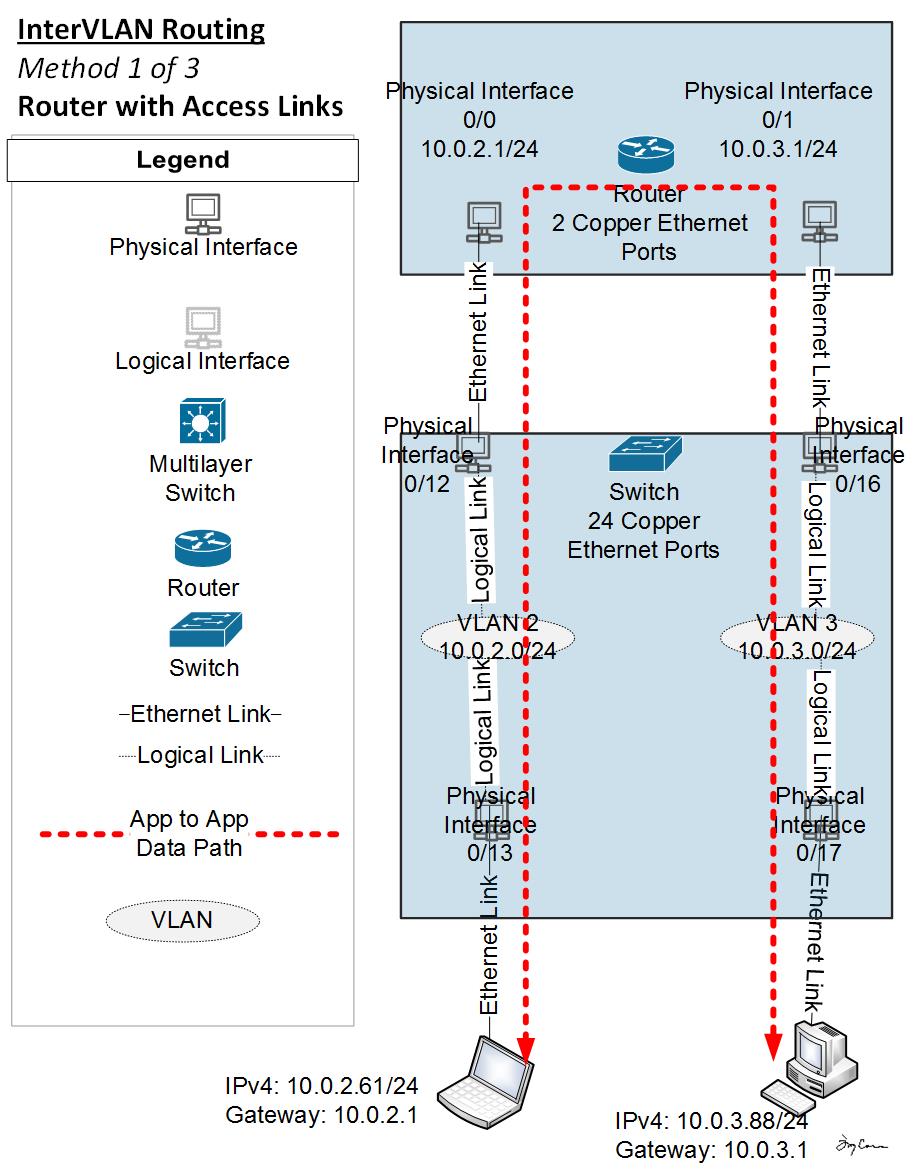
* Legacy routing: one router port per VLAN. — Engineertcarman, CC BY-SA 4.0, via Wikimedia Commons. *
How it works:
- Each router interface connects to a switch port assigned to a specific VLAN
- Each router interface is configured with an IP (Internet Protocol) address that serves as the default gateway for hosts in that VLAN
- When a host wants to reach another VLAN, it sends the packet to its default gateway (the router interface)
- The router routes the packet out the interface connected to the destination VLAN
Why it doesn't scale:
- A router with 4 Ethernet interfaces can only route between 4 VLANs
- Each connection wastes a switch port too
- Adding more VLANs means buying more routers or NICs (Network Interface Cards)
This method is no longer implemented in modern switched networks and is only covered for historical understanding.
Go deeper:
 Inter-VLAN Routing Operation (Cisco Press) — contrasts legacy one-interface-per-VLAN against router-on-a-stick and L3 switches, and why it doesn't scale.