Quiz Entry - updated: 2026.08.02
How does Prof. U. Maurer classify cryptographic systems and primitives?
He splits them into three categories: Unkeyed, Secret-Key, and Public-Key — each with distinct properties.
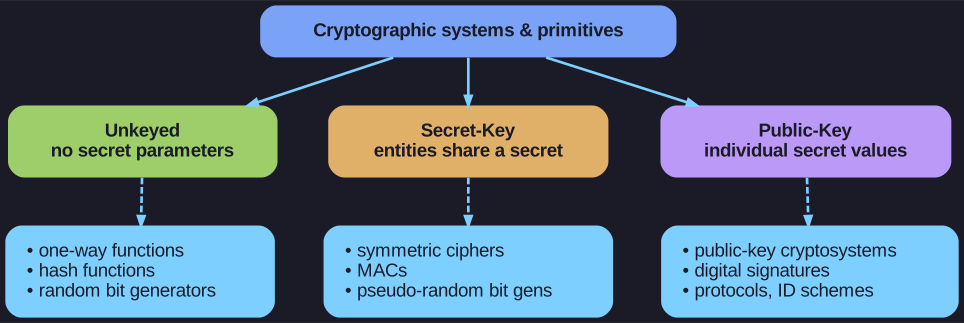
* Maurer's three categories of cryptographic primitives. *
| Category | Key Property | Examples |
|---|---|---|
| Unkeyed | No secret parameters | One-way functions, hash functions, random bit generators |
| Secret-Key | Two or more entities share a common secret value | Symmetric ciphers, MACs, pseudo-random bit generators |
| Public-Key | No shared secret keys; individual secret values, authentication of public keys | Public-key cryptosystems, digital signatures, various cryptographic protocols, payment systems, interactive proofs, identification schemes |
This is a more comprehensive taxonomy than the simple "symmetric vs. asymmetric" split, because it properly accounts for primitives that don't use keys at all.
Go deeper:
 Cryptographic primitive - matches the Unkeyed / Secret-Key / Public-Key taxonomy of primitives.