Quiz Entry - updated: 2026.07.30
How does Role-Based Access Control (RBAC) work, and why is it better than direct user-to-rights assignment?
Users get assigned roles; roles get assigned rights. The role is an intermediate layer that decouples user identity from permissions.
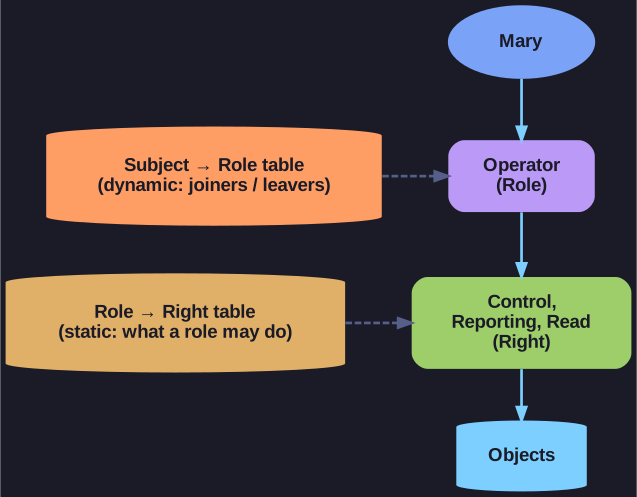
* The role decouples identity from permissions via two separately-maintained mappings. *
The model:
Subject (user)  →  Role  →  Rights  →  Objects
   Fred         Administrator    Admin    Directory
   Tom          Engineer         View, Control    Status, Switching
   Mary         Operator         Control, Reporting, Read    All
Two assignments are maintained separately:
- Subject-to-Role (dynamic — who has which job today)
- Role-to-Right (more static — what an "Operator" is allowed to do)
Why this beats direct user-to-right assignment:
- Joiners/leavers are easy: assign Mary the Operator role, all her permissions follow. Revoke the role when she leaves; all access dies at once.
- Audits are easier: you review the small set of role definitions, not every user's individual permissions.
- Consistency: five Operators all have identical rights — no drift over time.
- Without RBAC: every time a user joins, you have to manually click in each system to add the right permissions, and the data drifts immediately.
Static vs dynamic roles:
- Static: fixed by job — Administrator vs regular user.
- Dynamic: acquired by context — strongly authenticated users get more functions than weakly authenticated; a user in the building sees different things than one over VPN.
Tip: Active Directory groups, AWS IAM roles, Kubernetes RBAC, GitHub team permissions — all are RBAC at heart.
Go deeper:
 Role-based access control (Wikipedia) — the user–role–permission model and its NIST standardisation.