How does security-by-isolation score against the Basic Cyber Security Model, and where does it lead?
Badly on interaction: it blocks not only bad interaction but also the desired and permitted kind. Well on the system boundary: the isolation barrier is built exactly there. Today it is realistic only in special cases, and the natural next step is a perimeter model with a very restrictive perimeter.
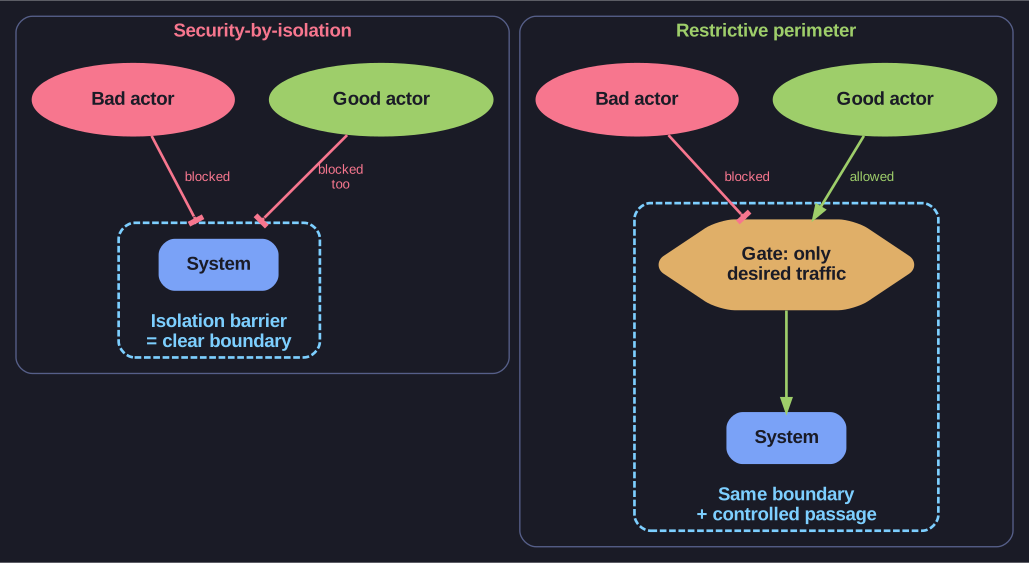
* Isolation blocks good and bad alike; a restrictive perimeter keeps the same boundary but lets desired traffic through. *
The Basic Cyber Security Model asks for only good actors doing good actions in a desired environment. Isolation achieves safety by preventing all actions, good ones included, so the system can hardly do its job.
Its strength is the clear definition of the system boundary, since that is where the barrier sits. Under today's requirements the model is no longer realistic, though there may be individual special cases where it makes sense. The obvious move is to the perimeter security model with a particularly restrictive perimeter definition: keep the boundary, but let controlled, desired interaction through.
Go deeper:
 SEL — Deny-by-Default Cybersecurity — a two-minute look at a very restrictive perimeter for industrial networks.
 NIST SP 800-41 Rev. 1 — Guidelines on Firewalls and Firewall Policy — how to write a deny-by-default rule set that only lets desired traffic pass.