Quiz Entry - updated: 2026.07.30
How does stateful DHCPv6 (Dynamic Host Configuration Protocol version 6) work, and what flag values trigger it?
RA (Router Advertisement) flags A=0, O=0, M=1 — the host does NOT use SLAAC (Stateless Address Autoconfiguration) for addressing; instead, it contacts a DHCPv6 server for all IPv6 configuration including the GUA (Global Unicast Address).
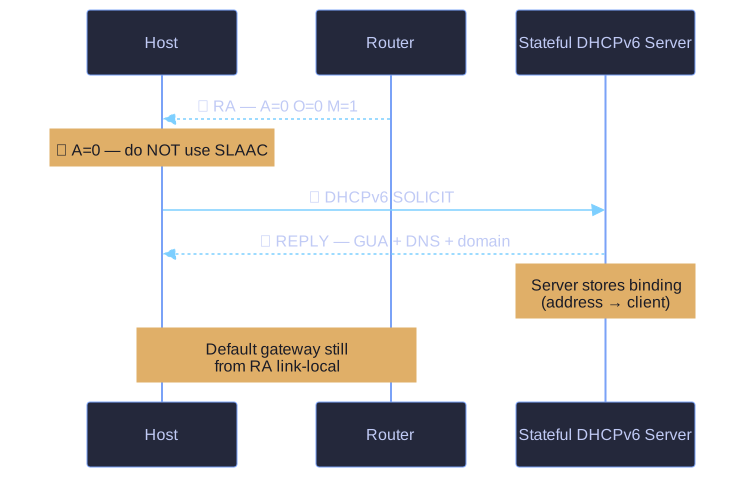
* Stateful DHCPv6 (A=0,O=0,M=1). *
How it works:
- Host receives an RA with A=0, O=0, M=1
- Host does not create its own GUA — the A flag tells it not to use SLAAC
- Host sends a DHCPv6 SOLICIT to find a stateful DHCPv6 server
- Server assigns a GUA, DNS (Domain Name System), domain name, and all other configuration
- Server maintains a binding table mapping addresses to clients
What the server provides:
- IPv6 GUA (the address itself)
- DNS server address(es)
- Domain name
- All other IPv6 configuration parameters
What still comes from the RA:
- The default gateway is still the router's link-local address from the RA — DHCPv6 does not provide a default gateway (unlike DHCPv4 (Dynamic Host Configuration Protocol version 4)!)
Cisco IOS (Internetwork Operating System) command to enable:
R1(config-if)# ipv6 nd managed-config-flag
Tip: Even with stateful DHCPv6, the host still needs the RA to learn the default gateway. The RA is never skipped — it's always the starting point in IPv6 dynamic configuration.
Go deeper:
 DHCPv6 — stateful & DUID (Wikipedia) — server-assigned addresses and the binding/DUID model.
- RFC 4861 — Managed-config (M) flag — the M flag that signals get-addresses-from-DHCPv6.