Quiz Entry - updated: 2026.07.30
How does stateless DHCPv6 (Dynamic Host Configuration Protocol version 6) work, and what flag values trigger it?
RA (Router Advertisement) flags A=1, O=1, M=0 — the host creates its own GUA (Global Unicast Address) via SLAAC (Stateless Address Autoconfiguration), then contacts a DHCPv6 server only for additional info like DNS (Domain Name System) and domain name.
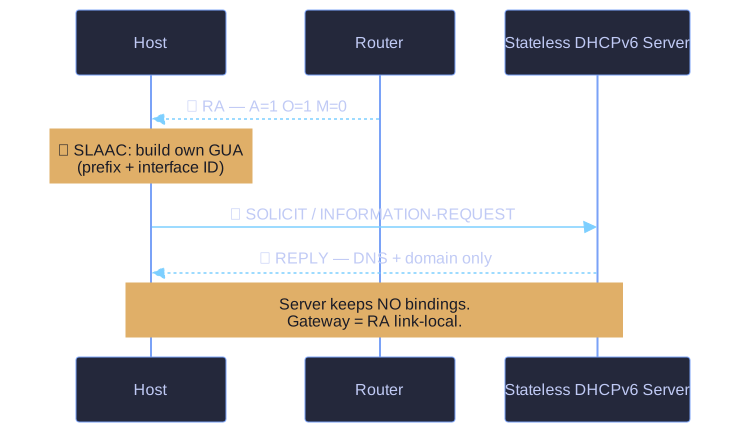
* Stateless DHCPv6 (A=1,O=1,M=0). *
How it works:
- Host receives an RA with A=1, O=1, M=0
- Host uses SLAAC to create its own GUA (prefix from RA + self-generated interface ID)
- Host sends a DHCPv6 SOLICIT to find a stateless DHCPv6 server
- Server responds with additional configuration (DNS server, domain name, etc.)
What the server provides:
- DNS server address(es)
- Domain name
- Other configuration parameters
What the server does NOT provide:
- IPv6 address (the host already created one via SLAAC)
- Default gateway (comes from the RA's source link-local address)
Why "stateless"?
- The DHCPv6 server does not maintain a list of address bindings — it doesn't know or care which addresses clients are using
- It only hands out supplementary configuration parameters
Tip: Think of stateless DHCPv6 as "SLAAC does the heavy lifting (addressing), the server just fills in the details (DNS, domain)."
Go deeper:
 RFC 8415 §5.1 — Information-request exchange — the two-message exchange for config (DNS/domain) without an address — the O=1 case.