How does systemic thinking differ from the ordinary linear-analytical thinking it offers an alternative to?
Analytical thinking breaks a thing into parts and traces single causes in straight lines; systemic thinking keeps the whole and looks at how parts influence each other in loops.
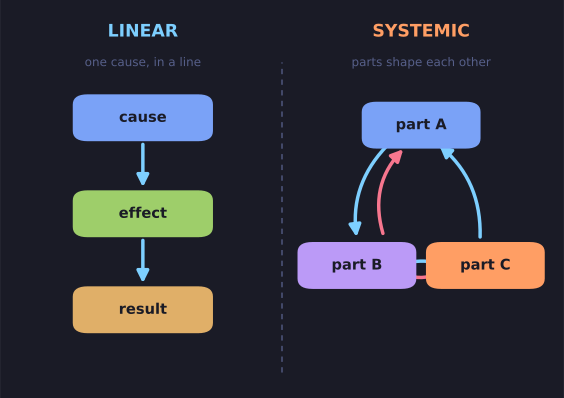
* Linear thinking traces one cause down a line; systemic thinking follows how parts influence each other in loops. *
| Dimension | Linear / analytical thinking | Systemic thinking |
|---|---|---|
| Strategy | Split into parts, study each | Keep the whole, study the relationships |
| Causality | One cause → one effect, in a line | Many mutual influences, in loops |
| Focus | The individual elements | The dynamics between elements |
| Dimensions | One factor at a time | Multidimensional, multicausal |
| Stance | Find the answer | Explore broadly, reflect without judging |
Analytical thinking is powerful and not "wrong" — for a clock you can take it apart. But for living things — a body, a team, an ecosystem, a society — the behaviour lives in the interactions, so dismantling them destroys exactly what you wanted to understand. Systemic thinking is the complement: it asks how do these parts shape each other over time? rather than which part is to blame?
Tip: Linear asks "what caused this?"; systemic asks "what is this part of?"