Quiz Entry - updated: 2026.07.30
How does the 4G LTE architecture differ from 3G UMTS, and what are the key new components?
4G LTE replaced the split CS/PS core with a unified all-IP Evolved Packet Core (EPC), simplified the radio access to a flat architecture (eNodeB, no RNC), and introduced new core nodes: MME, S-GW, P-GW, and HSS.
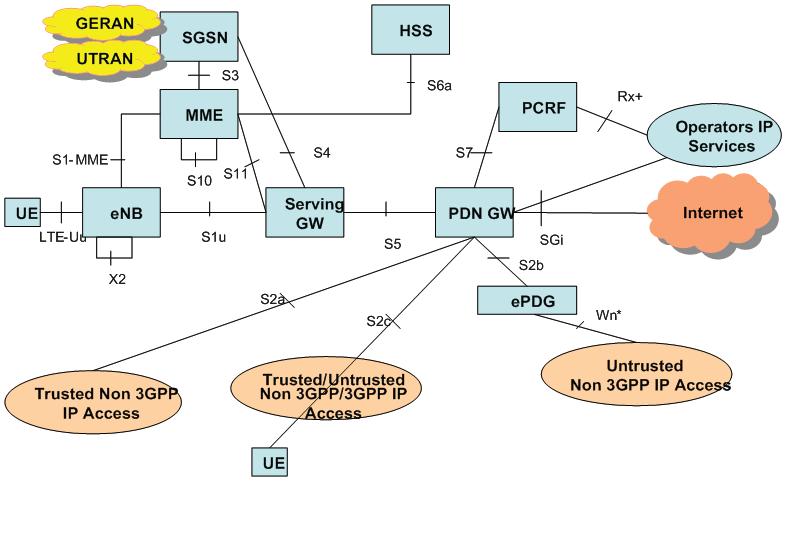
* Flat LTE architecture: eNodeB plus the EPC nodes (MME, S-GW, P-GW, HSS). — Public domain, via Wikimedia Commons. *
3G vs 4G architecture comparison:
| Aspect | 3G (UMTS) | 4G (LTE) |
|---|---|---|
| Radio access | Node B → RNC (hierarchical) | eNodeB (flat, no RNC) |
| Voice core | MSC → GMSC (circuit-switched) | Eliminated — VoLTE over EPC |
| Data core | SGSN → GGSN | S-GW → P-GW (Serving/Packet Data Gateway) |
| Subscriber DB | HLR + VLR | HSS (Home Subscriber Server, combines HLR+VLR) |
| Mobility/Control | MSC + SGSN | MME (Mobility Management Entity) |
| Transport | Mix of circuit + packet | All IP — everything is IP packets |
4G LTE core components:
- MME (Mobility Management Entity) — handles signaling: authentication, session management, mobility (but NOT user data)
- HSS (Home Subscriber Server) — like HLR+VLR combined — subscriber database
- S-GW (Serving Gateway) — local anchor for user data, handles handover between eNodeBs
- P-GW (Packet Data Network Gateway) — connects to the internet, assigns IP addresses (like GGSN)
Key architectural shift: In 4G, the control plane (signaling via MME) is separated from the user plane (data via S-GW/P-GW). This is a critical design principle that 5G takes even further.
Go deeper:
 EUTRAN + EPC main components (ShareTechnote) — a concise role-by-role breakdown of eNodeB, MME, S-GW, P-GW and HSS, splitting cleanly into "radio access vs core" so each box's job is unambiguous.
- System Architecture Evolution / EPC (Wikipedia) — best on the why: the flat all-IP design and the explicit control-plane / user-plane separation (incl. the later Sx/PFCP CUPS split that 5G inherits).
- Evolved Packet Core (Wikipedia) — kept for the carousel diagrams of the EPC node-and-interface layout (MME, S-GW, P-GW, HSS).