Quiz Entry - updated: 2026.10.26
How does the basic encryption model work, and what are $K_E$ and $K_D$?
$K_E$ is the encryption key and $K_D$ is the decryption key — in symmetric crypto they are the same, in asymmetric crypto they differ.
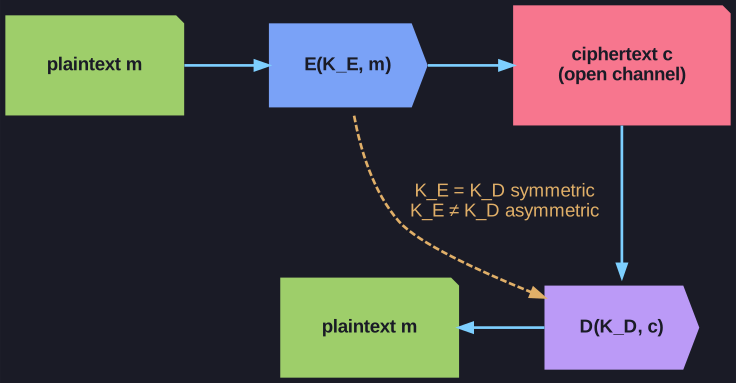
* Encrypt with $K_E$, decrypt with $K_D$; symmetric means $K_E = K_D$, asymmetric means they differ. *
The encryption model:
$$m \xrightarrow{E(K_E, m)} c \xrightarrow{D(K_D, c)} m$$
Where:
- $m$ = plaintext message
- $c$ = ciphertext
- $E$ = encryption function
- $D$ = decryption function
- $K_E$ = encryption key
- $K_D$ = decryption key
Key relationship:
- Symmetric: $K_E = K_D$ (same secret key shared between Alice and Bob)
- Asymmetric: $K_E \neq K_D$ (public key encrypts, private key decrypts)
The fundamental requirement is: $D(K_D, E(K_E, m)) = m$ — decryption must perfectly reverse encryption.
Go deeper:
 Symmetric-key algorithm — the same-key case.
- Public-key cryptography — the different-key case.