Quiz Entry - updated: 2026.10.15
How does the computational effort of ECC compare to RSA for equivalent security levels?
For 128-bit security: RSA needs ~4600 modular multiplications with 3072-bit numbers. ECC needs only ~380 point operations with 256-bit numbers — about 8% of RSA's work, with each operation also being faster.
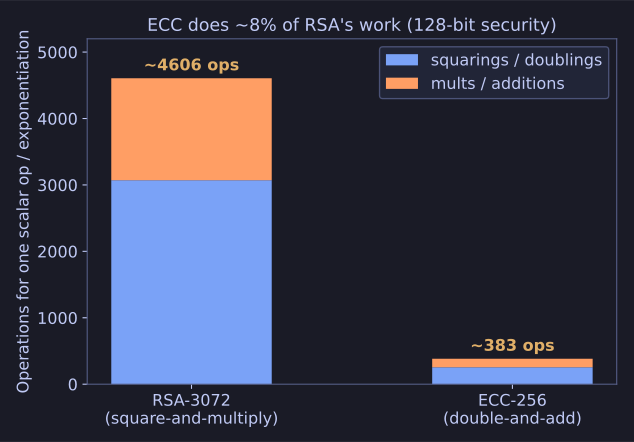
* ECC wins twice: far fewer operations (~380 vs ~4600) and each on much smaller numbers (256-bit vs 3072-bit). *
The comparison (128-bit security):
| RSA (3072 bit) | ECC (256 bit) | |
|---|---|---|
| Algorithm | Square-and-Multiply (SAM) | Double-and-Add (DAA) |
| Squarings/Doublings | ~3071 | ~255 |
| Multiplications/Additions | ~1535 | ~128 |
| Total operations | ~4600 | ~380 |
| Ratio | 100% | ~8% |
But it's even better than 8% suggests:
- Each RSA operation uses 3072-bit numbers → very large multiplications
- Each ECC operation uses 256-bit numbers → much smaller, faster operations
- The combination of fewer operations AND smaller numbers makes ECC dramatically faster
For 256-bit security:
- RSA would need ~15,360-bit keys → ~23,000 operations with huge numbers
- ECC needs 512-bit keys → ~760 operations with moderate numbers
- The gap widens as security levels increase — RSA scales terribly
Tip: This is why migrating to ECC is increasingly recommended. RSA beyond 3072 bits becomes increasingly impractical, while ECC scales linearly.
Go deeper:
 Corbellini — ECC part 4: breaking security and comparison with RSA — the key-size and work comparison in depth.
- Elliptic-curve cryptography — Wikipedia — the 256-bit-ECC ≈ 3072-bit-RSA equivalence.